T-Mobile Physically Cut a Cable to Kick China-Linked Hackers Out of Its Network
Sometimes the best cybersecurity solution is not another piece of software.
Sometimes, it is a pair of scissors.
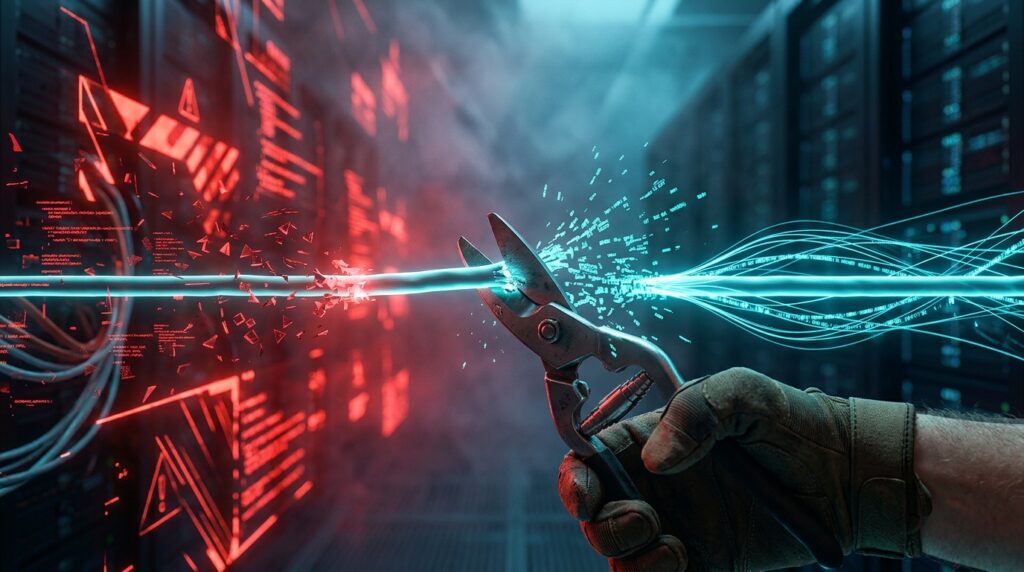
New reporting from Bloomberg has revealed how T-Mobile responded after discovering suspected Chinese government-backed hackers inside its network in 2024. According to the report, the telecom giant eventually took the unusual step of physically cutting a network cable to immediately disconnect a compromised system from the outside world.
The incident was linked to Salt Typhoon, a China-backed hacking group accused of targeting telecommunications companies and internet infrastructure around the world.
While several major telecom providers were reportedly compromised during the broader campaign, T-Mobile appears to have limited the damage by detecting suspicious activity relatively early and taking aggressive action.
What Happened at T-Mobile?
During 2024, T-Mobile’s cybersecurity team was investigating signs that attackers may have gained access to parts of its network.
The problem was finding them.
According to Bloomberg, T-Mobile’s security staff spent months searching its systems for evidence of the suspected intruders without initially being able to locate the source.
Eventually, investigators noticed something unusual.
Suspicious activity on one T-Mobile system appeared to be coming through a router belonging to another telecommunications company. T-Mobile has not publicly identified that provider.
That discovery helped the company’s security team narrow down where the compromise was happening.
Once they located the affected equipment, T-Mobile’s response became surprisingly physical.
The Cybersecurity Chief Grabbed a Pair of Scissors
T-Mobile cybersecurity chief Jeff Simon reportedly traveled with three other employees to a data center near the company’s Bellevue, Washington headquarters.
Their goal was simple: isolate the compromised equipment before the attackers could continue using it.
Rather than relying entirely on remote commands or software controls, the team located the affected system and cut the physical cable connecting it to the outside network.
That immediately removed the machine’s external connection.
In cybersecurity terminology, this is essentially an extreme form of network isolation.
If a compromised system cannot communicate with the attacker, it becomes significantly harder for hackers to continue issuing commands, stealing information, or moving deeper into the network.
It may sound old-fashioned, but in an emergency, physically disconnecting equipment can be one of the fastest ways to contain an active intrusion.
Who Is Salt Typhoon?
Salt Typhoon is the name security researchers have given to a sophisticated hacking group associated with the Chinese government.
The group has been linked to a large cyber-espionage campaign targeting telecommunications and internet infrastructure.
Unlike ransomware gangs that normally attack companies to extort money, state-backed groups frequently have a different objective:
intelligence collection.
Telecommunications networks are especially valuable targets because they can potentially provide access to massive amounts of communication-related information.
Reports surrounding the Salt Typhoon campaign have indicated that attackers were interested in information including phone records and communications connected with high-ranking U.S. officials.
Targets linked to the wider campaign have included major telecommunications and infrastructure companies such as:
- AT&T
- Verizon
- Viasat
- Charter Communications
- Windstream
Reports have suggested that hundreds of telecommunications, internet and data-center organizations around the world may have been affected by the broader operation.
That makes Salt Typhoon much more than an ordinary corporate data breach.
It represents a wider battle over access to the infrastructure that carries global communications.
Why Telecom Companies Are Such Valuable Targets
Think about everything that moves through telecommunications infrastructure.
Phone calls.
Text messages.
Internet traffic.
Location information.
Customer account records.
Business communications.
Government communications.
A telecom provider sits at the center of an enormous amount of digital activity.
Attackers who successfully compromise certain telecommunications systems may gain intelligence that would be extremely difficult to obtain through attacks against individual users.
That is why telecom infrastructure has become an attractive target for nation-state cyber operations.
Instead of hacking thousands of people individually, attackers may attempt to compromise infrastructure that already connects millions of users.
T-Mobile’s Response Shows Why Network Isolation Still Matters
The most interesting part of the T-Mobile story is not necessarily the scissors.
It is the security principle behind them.
When cybersecurity teams discover a compromised device, one of their first priorities is often containment.
The goal is to prevent the attacker from communicating with the compromised system or moving into other parts of the organization.
Usually, security teams accomplish this digitally by:
- blocking network traffic
- disabling accounts
- shutting down servers
- changing firewall rules
- revoking credentials
- segmenting affected systems
But if investigators believe an attacker still has active access and other methods are too slow or uncertain, physically disconnecting equipment can accomplish the same goal immediately.
No internet connection.
No command-and-control traffic.
No easy route back into the system.
It is cybersecurity at its most basic level.
There Is Another Important Lesson: Detection Can Take Time
T-Mobile’s experience also highlights a much bigger cybersecurity problem.
Sophisticated attackers do not always behave like traditional hackers.
They may deliberately remain quiet.
Instead of immediately encrypting files or crashing systems, espionage groups often try to maintain access without being discovered.
That means an organization can potentially have an attacker inside its environment while normal business operations continue.
Security teams therefore have to look for subtle warning signs such as:
- unusual authentication activity
- unexpected connections between systems
- abnormal network traffic
- unfamiliar administrator accounts
- suspicious router configurations
- connections to previously unknown infrastructure
The longer an attacker remains undetected, the more opportunities they may have to explore the network and collect information.
What Businesses Can Learn From T-Mobile
You do not need to operate a massive telecom network to learn something from this incident.
The same cybersecurity principles apply to businesses of almost every size.
1. Assume attackers may already be inside
Cybersecurity should not focus only on preventing hackers from entering.
Organizations also need systems capable of detecting suspicious activity after an attacker gets through the front door.
This is often referred to as an assume-breach approach.
2. Segment important systems
One compromised computer should not automatically provide access to the entire organization.
Network segmentation can prevent attackers from moving freely between departments, servers and sensitive databases.
3. Have an emergency isolation plan
Companies should know exactly how to disconnect compromised equipment.
That could involve disabling network ports, shutting down cloud resources, blocking accounts or physically disconnecting hardware.
Security teams should not be figuring this out for the first time during an attack.
4. Monitor unusual network behavior
Unexpected connections between devices can reveal attackers who would otherwise remain hidden.
Network monitoring and endpoint detection tools can help security teams identify these patterns.
5. Protect network infrastructure itself
Companies often focus heavily on laptops and servers while overlooking routers, switches and other network equipment.
Those devices can be extremely valuable targets because they control how information moves throughout an organization.
The Bigger Picture
The Salt Typhoon campaign demonstrates how cybersecurity has evolved beyond criminals trying to steal passwords or demand ransom payments.
Governments increasingly view telecommunications networks, cloud infrastructure and internet systems as strategic intelligence targets.
For businesses, that means cybersecurity is becoming less about simply protecting individual computers and more about understanding the entire digital environment.
Devices.
Routers.
Cloud accounts.
Third-party providers.
Network connections.
Employee identities.
All of them can become pathways into an organization.
T-Mobile’s decision to physically cut a cable may sound dramatic, but it illustrates one of the oldest principles in cybersecurity:
When you know a system is compromised, isolate it before the attacker can do more damage.
Sometimes sophisticated cyber defense requires artificial intelligence, advanced threat detection and massive security platforms.
And sometimes it requires scissors.
Aqyreon Takeaway
The T-Mobile incident is a reminder that cybersecurity technology alone cannot protect an organization.
Companies also need security teams that can recognize unusual behavior, investigate patiently and act quickly when something goes wrong.
For business owners, the question should not simply be:
“Can hackers get into our network?”
A more useful question is:
“If someone gets in, how quickly would we notice — and how quickly could we shut them out?”
That difference can determine whether an intrusion becomes a manageable security incident or a major data breach.