
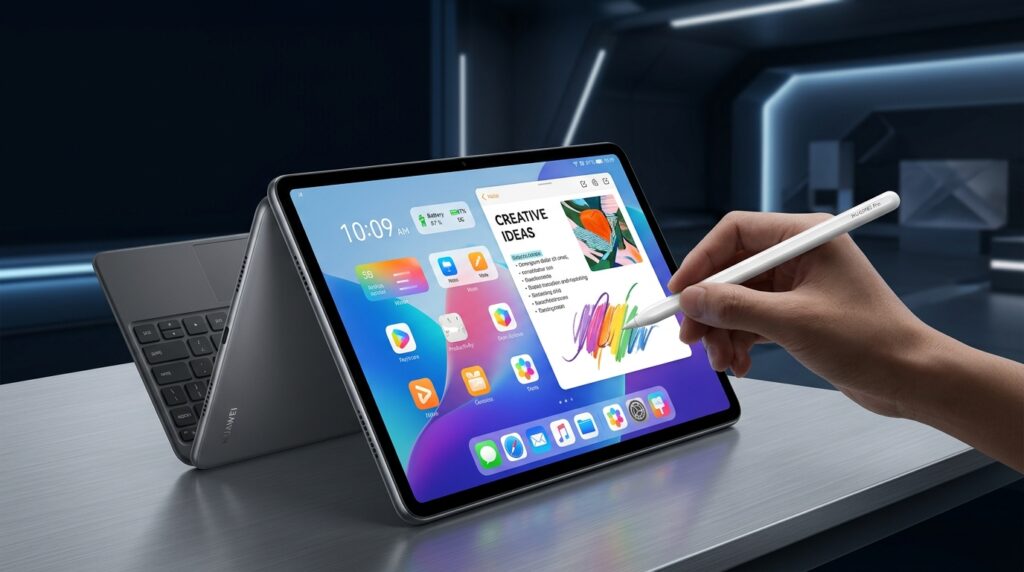
Huawei MatePad Air (2026) Gets a Major OLED Upgrade — Here’s What’s New
Huawei has refreshed its MatePad Air lineup for 2026, and this year’s model brings one particularly important upgrade: a much better display.
Unveiled alongside Huawei’s Pura 90s series, FreeClip 2 S and other new devices, the MatePad Air (2026) keeps the slim, productivity-focused design of its predecessor while moving closer to Huawei’s more premium MatePad Pro tablets.
Here’s what has changed and why it matters.
The Biggest Upgrade Is the New OLED Display
The MatePad Air (2026) still features a large 12-inch screen, but Huawei has replaced the previous IPS LCD panel with an OLED display.
That means users should get deeper blacks, stronger contrast and a more premium viewing experience.
The display also supports a 144Hz refresh rate, which should make scrolling, animations, gaming and general navigation feel noticeably smoother.
But arguably the more interesting feature is Huawei’s PaperMatte display coating.
PaperMatte is designed to reduce reflections and give the screen a more paper-like appearance. That could make the tablet especially appealing to people who spend long periods reading documents, taking notes or working under bright indoor lighting.
Previously, features like PaperMatte were more closely associated with Huawei’s higher-end MatePad Pro devices. Bringing the technology to the MatePad Air makes the cheaper model considerably more attractive.
Huawei Is Also Focusing on Entertainment
The improved screen isn’t the only multimedia upgrade.
Huawei has equipped the tablet with a six-speaker stereo system, giving the MatePad Air more audio hardware for movies, music, gaming and video calls.
Combined with the OLED screen and 144Hz refresh rate, the tablet appears positioned as both a productivity device and an entertainment machine.
Kirin T93C Powers the Tablet
Inside the MatePad Air (2026) is Huawei’s Kirin T93C processor.
Huawei is offering two memory configurations:
- 8GB RAM
- 12GB RAM
Storage is less flexible.
Both versions come with 256GB of storage, with no additional storage configurations currently offered.
Huawei also says the Kirin T93C provides enough performance to support some of the company’s AI-powered Pro features, suggesting AI capabilities are becoming a bigger part of Huawei’s tablet strategy.

Huawei Simplified the Camera System
Huawei has also made an interesting change to the rear cameras.
Instead of carrying over the dual-camera setup from the previous generation, Huawei has removed the secondary 8MP ultrawide camera.
The new MatePad Air now has a single:
50MP main rear camera
For video calls and selfies, there is also a:
12MP front-facing camera
Removing the ultrawide camera probably won’t be a major drawback for most tablet users. Cameras are rarely the main reason people buy large productivity tablets, and simplifying the hardware could allow Huawei to concentrate resources elsewhere.
A Huge 10,100mAh Battery
Battery capacity is another strong point.
Huawei has fitted the MatePad Air (2026) with a sizeable 10,100mAh battery.
It also supports 66W fast charging, which should help reduce charging time despite the tablet’s large battery.
For people who use tablets for work, school, streaming or travel, that combination could make the MatePad Air particularly useful as an all-day device.
It Is Surprisingly Thin for a 12-Inch Tablet
Despite its large screen and battery, Huawei has managed to make the tablet considerably lighter.
The MatePad Air (2026) measures just:
5.3mm thick
and weighs:
509 grams
That represents roughly a 50-gram weight reduction compared with the previous generation.
For a device with a 12-inch OLED display and 10,100mAh battery, that is an impressive reduction.
Huawei will offer the tablet in three colors:
Sakura Pink, Airy Blue and White.
Keyboard and M-Pencil Pro Support Turn It Into a Productivity Device
Huawei continues to position the MatePad Air as more than just a media tablet.
The device supports the company’s detachable keyboard, which Huawei commonly includes with launch bundles.
It also works with the Huawei M-Pencil Pro.
The stylus supports several smart features, including an interesting capability called Air Mouse.
Air Mouse allows users to perform certain interactions with the tablet from a short distance without physically touching the screen.
For presentations, productivity workflows and creative applications, features like this could help Huawei differentiate the MatePad Air from more conventional Android tablets.
MatePad Air (2026) Key Specifications
| Feature | Huawei MatePad Air (2026) |
|---|---|
| Display | 12-inch OLED |
| Refresh rate | 144Hz |
| Display technology | PaperMatte |
| Processor | Kirin T93C |
| RAM | 8GB or 12GB |
| Storage | 256GB |
| Rear camera | 50MP |
| Front camera | 12MP |
| Battery | 10,100mAh |
| Charging | 66W fast charging |
| Thickness | 5.3mm |
| Weight | 509g |
| Speakers | Six-speaker stereo system |
| Stylus support | Huawei M-Pencil Pro |
| Colors | Sakura Pink, Airy Blue, White |
Aqyreon Take: Huawei Is Making the MatePad Air Harder to Ignore
The MatePad Air (2026) doesn’t completely reinvent Huawei’s tablet formula. Instead, Huawei appears to have focused on improving the parts users interact with the most.
The switch from LCD to a 144Hz OLED PaperMatte display is easily the biggest improvement.
Add the 10,100mAh battery, thinner design, six-speaker setup and M-Pencil Pro support, and the MatePad Air begins to look much closer to a premium productivity tablet than its position in Huawei’s lineup might suggest.
The biggest limitations may be the fixed 256GB storage configuration and Huawei’s software ecosystem, particularly for buyers outside markets where Huawei’s services are widely used.
Still, for users primarily interested in reading, note-taking, drawing, media consumption and lightweight productivity, the MatePad Air (2026) could be one of Huawei’s more interesting tablet releases this year.
The Bottom Line
Huawei hasn’t simply made the MatePad Air thinner.
It has given the device the kind of screen technology normally associated with much more expensive tablets.
And for many buyers, that 12-inch 144Hz OLED PaperMatte display could be the feature that makes the MatePad Air (2026) worth paying attention to.