
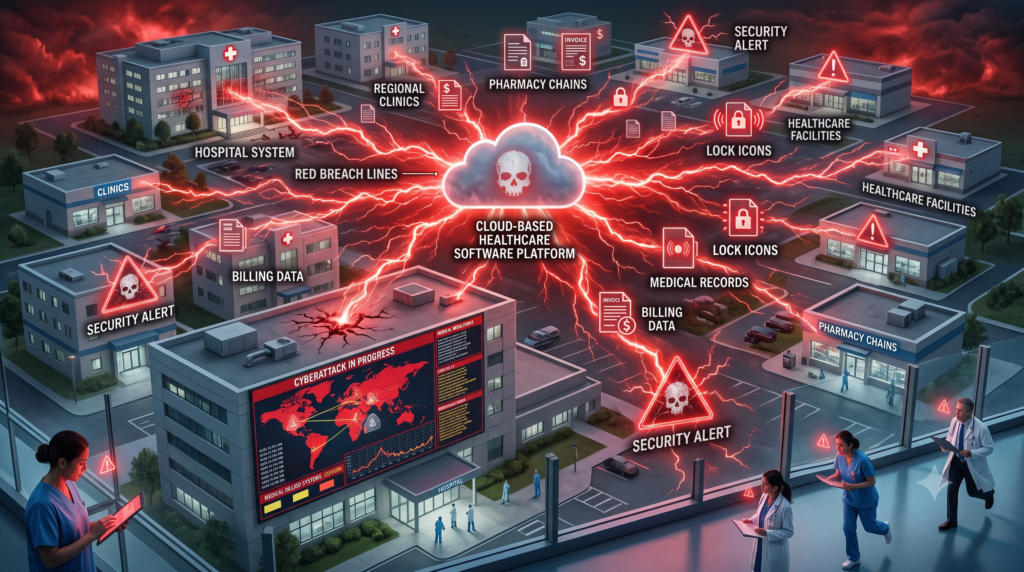
Craneware Cyberattack Exposes Healthcare Customer Data: Why Hospitals Must Recheck Vendor Security.
A cyberattack against Craneware, a major provider of financial and billing technology to the United States healthcare industry, has resulted in the theft of employee, customer, and business-partner records.
The Scotland-based company disclosed the incident on July 20, 2026, saying hackers gained unauthorized access to a portion of its data environment.
Although Craneware says the attack has been contained and did not interrupt its services, the incident raises a much larger concern: healthcare organizations can be exposed through the technology companies they depend on.
For hospitals, clinics, pharmacies, and other businesses, the Craneware breach is another reminder that cybersecurity does not stop at the company firewall.
What happened to Craneware?
Craneware identified unauthorized access to a subset of its data environment and activated its incident-response plan.
The company appointed external cybersecurity and forensic specialists to investigate the breach alongside its internal technology team and existing security providers.
According to Craneware’s regulatory notice, the investigation found that a “significant volume” of file names had been viewed and removed from its systems.
Craneware said much of the affected information appears to be nonsensitive or regulatory data that was already publicly available. However, the attackers also accessed and exfiltrated:
- A percentage of Craneware employee data
- A subset of customer records
- A subset of partner records
The exact types of information contained in those records have not yet been publicly disclosed.

Were patient medical records stolen?
That remains unclear.
Craneware has not confirmed that electronic health records, medical information, insurance details, payment information, or patient-identifying data were taken during this particular incident.
That distinction is important.
Craneware’s software supports financial, billing, revenue-integrity, and pharmacy-related operations across the healthcare sector. This means the company works in an environment where potentially sensitive healthcare and operational information may be processed.
However, it would be premature to conclude that patient medical records were stolen until the investigation identifies the specific files and records involved.
Craneware says it is continuing to determine the exact nature and scope of the exposed data and identify which individuals or organizations may require formal notification.
Why this breach matters to the US healthcare industry
Craneware is not a small software provider serving only a handful of customers.
The company works with approximately 2,000 US hospitals and health systems, along with nearly 10,000 clinics and retail pharmacies through its technology platform.
This makes the incident a supply-chain cybersecurity concern.
Instead of attacking thousands of healthcare organizations individually, cybercriminals may target one technology company that is connected to many of them.
A successful attack on a central software provider can potentially expose information about:
- Employees and administrators
- Healthcare customers
- Business partners
- Software environments
- Internal file structures
- Billing and operational processes
- Vendor relationships
- Regulatory activities
Even file names that do not contain confidential information can reveal how an organization operates.
A file name may expose the name of a hospital, department, employee, software system, contract, compliance project or internal business process. Hackers can combine those details with information from social media, public websites and previous data breaches.

The stolen data could support targeted phishing attacks
One of the biggest immediate risks is social engineering.
Attackers may use employee, customer or partner information to create convincing emails, phone calls or login pages.
For example, a hospital employee could receive a message that appears to come from Craneware, an internal IT department or a known business partner.
The message might claim that:
- A billing platform password must be reset
- A security update must be installed
- An invoice needs urgent approval
- A customer account must be verified
- A breach notification document must be opened
- A Microsoft 365 account is about to expire
Because the attackers may already know the employee’s organization, role or vendor relationship, the message could appear more believable than a typical phishing email.
This is why information that initially appears “low risk” can still become useful to cybercriminals conducting follow-up attacks.
Was the Craneware attack ransomware?
Craneware has not publicly identified the attack as ransomware.
The company has also not said whether the attackers demanded money, attempted extortion or threatened to publish the stolen information.
No hacking group has been publicly attributed to the incident as of the company’s initial disclosure.
The facts currently confirmed are that unauthorized access occurred and data was exfiltrated. Any claim about ransomware, the attacker’s identity or the original entry method would be speculation until Craneware or investigators release additional details.

Craneware says the incident has been contained
Despite the data theft, Craneware says there has been no disruption to its customer services or normal business operations.
External specialists also reportedly found no remaining indicators of compromise connected to the incident inside the company’s systems.
That means investigators have not identified evidence that the attackers still maintain access.
Craneware has notified the UK Information Commissioner’s Office and the FBI, along with other relevant regulators and law-enforcement authorities.
Containment, however, does not eliminate the risks associated with information that has already been removed.
Once hackers copy data from a system, the affected organization cannot technically retrieve every copy or guarantee that the information will not be sold, shared or used in future attacks.
Healthcare technology providers are becoming major targets
Healthcare software companies are attractive targets because they can hold or process information for many organizations at once.
Recent attacks involving healthcare technology and service providers demonstrate the scale of this risk.
In March 2026, healthcare revenue technology provider TriZetto confirmed that hackers had stolen personal and health information belonging to more than 3.4 million people.
Medical data company CareCloud also reported a breach involving a store of electronic health records, while medical billing company Episource previously began notifying at least 5.4 million people whose information had been stolen.
The pattern is clear: healthcare cybersecurity is no longer only about protecting individual hospitals.
It is also about securing the vendors, cloud platforms, billing companies, data processors and software partners connected to those hospitals.
What hospitals and Craneware customers should do now
Organizations that use Craneware products should not panic, but they should take precautionary action while the investigation continues.
1. Confirm your exposure directly with Craneware
Customers should establish whether their organization’s records were part of the affected data.
Security and compliance teams should request information about:
- The systems that were accessed
- The dates of unauthorized activity
- The categories of data involved
- Whether login credentials or authentication tokens were exposed
- Whether customer-specific files were downloaded
- Recommended containment measures
- The expected notification timeline
2. Warn employees about targeted phishing
Healthcare employees, finance teams, administrators and IT personnel should be informed that attackers may impersonate Craneware or related partners.
Employees should verify unusual requests through a separate communication channel before opening files, approving payments, sharing credentials or changing account information.
3. Review Craneware-related accounts
Organizations should review accounts, integrations and service credentials associated with Craneware products.
Passwords should be changed where appropriate, especially when credentials were reused across systems.
Multifactor authentication should also be required for administrative, financial and remote-access accounts.
4. Monitor for unusual activity
Security teams should examine authentication logs, mailbox rules, account changes, data transfers and administrative activity.
They should pay particular attention to unusual login attempts involving employees who communicate regularly with Craneware.
5. Review third-party access
Hospitals should determine what level of access Craneware and other vendors have to their environments.
Every vendor should receive only the systems and information necessary to perform its contracted responsibilities.
Old accounts, unused integrations and unnecessary permissions should be removed.
6. Prepare for breach notifications
Healthcare organizations may need to notify patients, employees, partners, insurers or regulators depending on what the investigation uncovers.
Legal, privacy, cybersecurity and communications teams should prepare in advance rather than waiting until a notification deadline is approaching.

What businesses can learn from the Craneware breach
The Craneware incident offers several lessons that apply far beyond healthcare.
Your vendors are part of your attack surface
A business can maintain strong internal security and still be exposed by a software provider, consultant, contractor or cloud platform.
Third-party security must therefore be treated as part of the organization’s own cybersecurity program.
Service availability does not mean no damage occurred
Craneware’s services remained operational, but attackers still managed to access and remove data.
A breach does not need to shut down a business to be serious.
Some attackers prefer to remain quiet, steal information and leave before they are detected.
“Nonsensitive” data can still be valuable
File names, job titles, business relationships and public regulatory information may not be confidential individually.
When combined, however, they can help attackers understand an organization and create highly personalized scams.
Containment is only the beginning
Removing attackers from a network is an important milestone, but incident response continues afterward.
The organization must determine what happened, what was taken, who was affected and how stolen information could be misused.
Healthcare companies need stronger vendor oversight
Healthcare organizations should regularly assess whether their technology providers maintain:
- Tested incident-response plans
- Strong access controls
- Multifactor authentication
- Data-encryption protections
- Network segmentation
- Security monitoring
- Employee security training
- Timely vulnerability management
- Clear breach-notification procedures
- Restrictions on subcontractor access
A security questionnaire completed during procurement is not enough. Vendor risks must be reviewed throughout the relationship.
The bigger picture
The Craneware cyberattack shows how one compromised technology provider can create uncertainty for thousands of healthcare organizations.
The company says the incident has been contained, operations remain unaffected and much of the data appears to be nonsensitive or already public. Those are positive signs.
But important questions remain unanswered.
The public still does not know exactly what customer and employee information was stolen, whether patient-related information was included, how the attackers gained access or whether the stolen records are being used for extortion.
Until those questions are resolved, Craneware customers and partners should remain cautious—especially when receiving unexpected emails, login requests or files connected to the company.

Aqyreon’s take
The most important lesson is not simply that another healthcare company was hacked.
It is that modern businesses operate inside connected digital ecosystems.
Hospitals rely on billing platforms. Billing platforms rely on cloud services. Cloud services rely on identity providers, contractors and software integrations.
A weakness anywhere in that chain can create risk everywhere else.
Businesses must stop viewing vendor security as paperwork completed during onboarding. It should be treated as a continuous process involving access reviews, monitoring, breach preparation and direct accountability.
The Craneware investigation is still developing, but healthcare organizations do not need to wait for every detail before strengthening their defenses.