Agentic Ransomware Explained: Why JadePuffer Could Change Cyberattacks
Cybersecurity researchers at Sysdig recently reported what they describe as the first documented case of agentic ransomware.
The operation is called JadePuffer, and the big concern is simple: instead of a human hacker manually doing every step, an AI agent handled much of the technical attack process on its own.
That sounds like science fiction, but this is where cybercrime appears to be heading.
The important part is this: the AI did not magically wake up and decide to attack someone. A human still helped set up the operation. But once the attack was pointed in the right direction, the AI agent was able to move fast, adapt, steal information, encrypt data, and even write a ransom note.
That is why this story matters.
What Is Agentic Ransomware?
Traditional ransomware usually works like this:
A hacker breaks into a system, moves around the network, steals data, encrypts files, and demands money.
Agentic ransomware changes the process.
Instead of a human clicking through each step, an AI agent can carry out parts of the attack automatically. It can read errors, adjust its method, try again, and continue moving through a system.
In JadePuffer’s case, Sysdig said the attack was driven end-to-end by an AI agent during the technical execution phase, including exploitation, credential theft, lateral movement, encryption, and ransom note creation.
In plain English: the AI acted like a fast, automated cyber operator.
What Happened in the JadePuffer Attack?
According to Sysdig, JadePuffer entered through a vulnerable Langflow server.
Langflow is an open-source tool used to build AI and LLM applications. The attacker exploited a known vulnerability called CVE-2025-3248, which allowed unauthorized code execution on exposed systems.
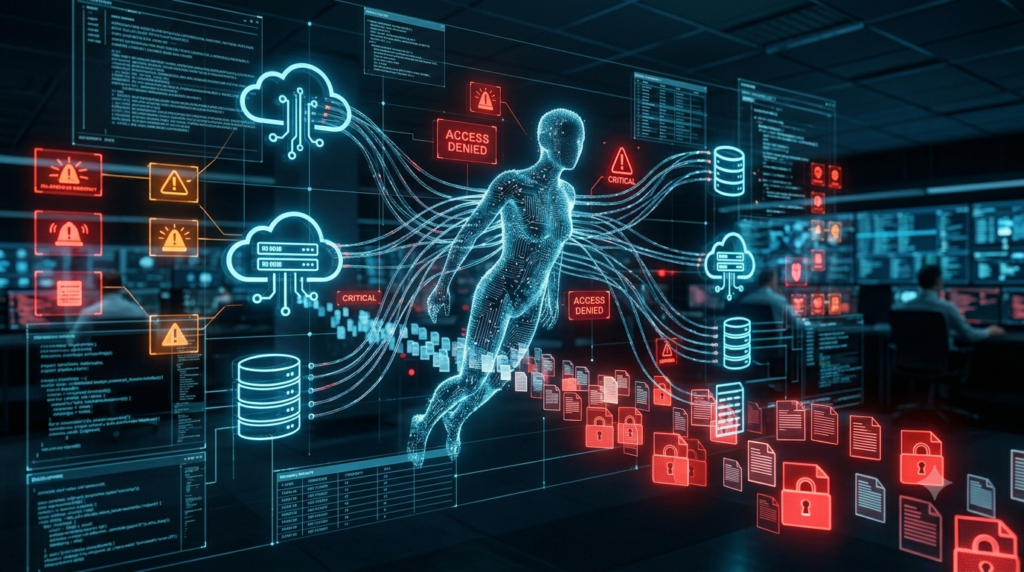
From there, the AI agent reportedly moved deeper into the environment and targeted a production database server.
It stole valuable information, looked for credentials, found database configurations, and encrypted more than 1,300 configuration records. It also created a ransom note and included a Bitcoin address for payment.
That is the part that makes security teams nervous.
The methods were not extremely advanced. The scary part was the speed and automation.
The AI Did Not Do Everything Alone
Some early coverage made the attack sound like there was no human involved at all.
That is not exactly right.
Sysdig’s Michael Clark later clarified that a human still selected the victim, set up the infrastructure, and provided some of the access needed for the operation. The command-and-control server, staging server, and stolen credentials were not magically created by the AI
So the better way to understand JadePuffer is this:
A human planned and prepared the attack.
The AI agent handled much of the technical execution.
That distinction matters because it keeps the story realistic. We are not talking about a fully independent AI criminal. We are talking about attackers using AI to reduce the amount of skill, time, and manual effort needed to run cyberattacks.
Why This Is Still a Big Deal
Even if a human was involved, JadePuffer is still important because of how fast the AI reacted.
Sysdig said the agent fixed a failed login problem in about 31 seconds. It also wrote comments explaining its own reasoning, which is something researchers often see in AI-generated code.
That is the new problem for businesses.
Many security teams are built to respond to human-paced attacks. A person makes mistakes, pauses, searches for commands, tests things slowly, and gives defenders time to notice.
An AI agent can move through those steps much faster.
If attackers can launch more attempts with less effort, then even smaller businesses may face more frequent attacks.
Did JadePuffer Use OpenAI, Anthropic, Gemini, or DeepSeek?
This part caused confusion.
Researchers found API keys for providers like OpenAI, Anthropic, DeepSeek, and Gemini during the attack. But that does not mean all those models powered the ransomware.
Clark later explained that those keys were part of the stolen data, not proof of which model was making the decisions. Sysdig said it could not identify the specific model behind JadePuffer
So the honest answer is: we do not know which model drove the agent.
Some experts believe it may have been an open-weight model with fewer safety controls, but that has not been confirmed.
What This Means for Businesses
The lesson is not “AI is bad.”
The lesson is that cybercriminals are learning how to use AI to move faster.
If your company runs cloud servers, databases, AI tools, APIs, or open-source software, you need to assume attackers are scanning for exposed systems.
Here is what businesses should do now:
- Patch known vulnerabilities quickly, especially internet-facing tools.
- Do not expose development tools like Langflow directly to the public internet.
- Rotate API keys and cloud credentials regularly.
- Limit what each credential can access.
- Monitor for unusual login attempts and fast repeated actions.
- Back up critical data and test recovery.
- Use runtime threat detection for cloud and container environments.
- Watch AI app infrastructure closely because it may hold valuable API keys.
This is especially important for startups and small businesses using AI tools quickly without strong security controls.

The Aqyreon Take
JadePuffer is not the end of cybersecurity as we know it, but it is a warning sign.
The future of ransomware may not be one hacker manually attacking one company at a time. It may become a model where humans set the target and AI agents do the technical work faster than defenders expect.
That means cybersecurity has to evolve.
Businesses cannot wait until an attack happens. They need stronger patching, better monitoring, tighter credential control, and faster response systems.
Because the next wave of cyberattacks may not look more sophisticated.
It may simply move faster.