
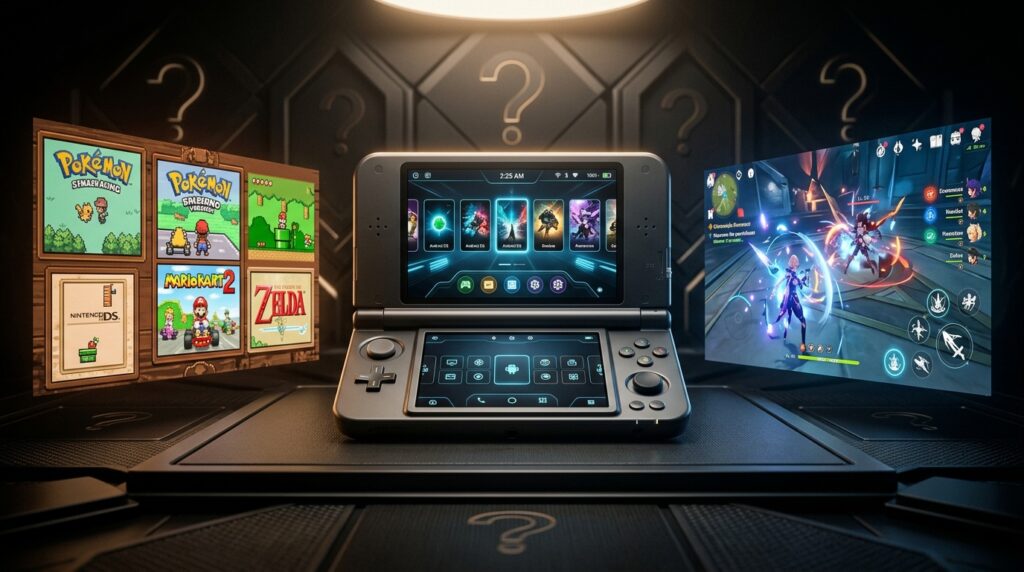
Retroid Pocket Duo Preview: Dual OLED Screens, Specs, Price Expectations and DS Gaming
Retroid is building a dual-screen Android handheld with OLED displays, a clamshell design, and serious Nintendo DS nostalgia. But the Pocket Duo’s price, performance, hinge quality, and software experience will ultimately decide whether it is a must-buy or just another interesting retro gaming device.
Retroid has built a strong reputation among retro-gaming fans by producing relatively affordable Android handhelds capable of running everything from classic 8-bit games to much more demanding systems.
Now the company is trying something different.
On September 7, 2026, Retroid teased the Retroid Pocket Duo, its first purpose-built handheld with two integrated displays. The company’s teaser described it simply as “Two Screens.. One Pocket,” while its silhouette immediately drew comparisons with Nintendo’s DS and 3DS handhelds.
And that comparison may be exactly what makes this device interesting.
Nintendo’s dual-screen systems created some of the most unusual portable games ever made. Modern handhelds can emulate those games, but squeezing two virtual displays onto one widescreen panel rarely recreates the original experience.
The Pocket Duo could change that.
What We Know About the Retroid Pocket Duo
Retroid has started revealing more details following the initial teaser.
According to information released so far, the Pocket Duo will feature two 120Hz OLED displays.
The upper display will use a 16:9 aspect ratio, while the lower screen will use a more traditional 4:3 layout. The device will also include a D-pad positioned higher on the controls alongside recessed dual analog sticks.
That combination makes the Pocket Duo more than just a Nintendo DS emulator.
The 4:3 display could work particularly well with older retro systems, while the wider upper screen could accommodate newer Android games, PSP titles, streaming services and other widescreen content.
In theory, that gives Retroid much more flexibility than simply copying the DS screen layout.
The Processor Is the Biggest Surprise
One specification may give potential buyers some pause.
Retroid reportedly plans to use Qualcomm’s Dragonwing Q-7790 processor rather than the more powerful QCS8550 used in the Pocket Nova.
The Pocket Nova’s QCS8550 is essentially a Snapdragon 8 Gen 2-class processor without the cellular modem, giving the device enough power for demanding emulation workloads.
The Pocket Duo’s Q-7790 is positioned closer to Snapdragon 7 Gen 4 territory.
That doesn’t automatically make it a bad decision.
In fact, it may be intentional.
A slightly less powerful processor could reduce manufacturing costs, improve battery efficiency and help Retroid keep the Pocket Duo within the affordable price range that helped make its previous handhelds popular.
But there is a tradeoff.
Buyers interested in demanding systems such as Nintendo Switch, higher-end Android games or more advanced emulation will want to see real-world benchmarks before buying.
The Pocket Duo Could Finally Make DS Emulation Feel Right
Nintendo DS emulation has always presented an unusual problem.
Most modern gaming handhelds have one display.
Nintendo DS games were designed around two.
You can technically run DS titles on a conventional Android handheld, but the experience usually involves placing both screens side-by-side, stacking them vertically or constantly switching between them.
None of those solutions really feels like using the original hardware.
A dedicated dual-screen handheld changes that equation.
The Pocket Duo could allow players to put gameplay on the upper screen while maps, inventories, menus or touch controls remain on the lower display — exactly the type of interaction many DS games were originally designed around.
If Retroid gets the software right, this could become one of the strongest reasons to buy the device.
But Retroid Isn’t Alone
The dual-screen retro handheld category is starting to get crowded.
Anbernic has already entered the space with its RG DS Plus, while AYN’s Thor takes a more premium approach with dual AMOLED displays.
That means Retroid doesn’t simply need to build a working dual-screen device.
It needs to build one that offers the right balance of:
- Performance
- Display quality
- Battery life
- Build quality
- Comfortable controls
- Software
- Price
Retroid’s biggest advantage could be value.
The company’s existing handhelds demonstrate how aggressively it can price capable hardware. For example, the Pocket Nova starts at around $229 and combines a 4.5-inch 120Hz AMOLED display with the powerful QCS8550 chipset.
If Retroid can keep the Duo somewhere near that territory, things could get very interesting.
The Hinge Could Make or Break the Pocket Duo
There is another specification that won’t appear prominently on most spec sheets:
the hinge.
A clamshell handheld is only as good as the mechanism connecting its two halves.
The hinge will be opened, closed and adjusted thousands of times during the device’s lifespan.
It needs to feel solid without becoming excessively stiff. It also needs to hold the upper display at different viewing angles without wobbling.
For a device built around two screens, hinge failure would be far more serious than a cosmetic inconvenience.
Retroid will need to prove that the Pocket Duo isn’t simply powerful — it also needs to survive years of portable gaming.
Price Will Probably Decide Everything
This may ultimately be the most important question.
How much will the Retroid Pocket Duo cost?
Retroid has not announced official pricing yet.
And that’s where the processor choice becomes particularly interesting.
Using the Dragonwing Q-7790 rather than a flagship-class Snapdragon chip could allow Retroid to keep costs under control while still providing enough performance for the systems most buyers will actually want to emulate.
If the Pocket Duo lands somewhere around $200 to $300, it could become one of the most compelling retro handhelds on the market.
Push too far above that range and buyers will start comparing it with much more powerful premium handhelds.
What Would Make the Pocket Duo Worth Buying?
For Aqyreon, the Pocket Duo becomes genuinely interesting if Retroid delivers five things.
First, excellent DS and 3DS emulation.
Dual screens alone aren’t enough. Switching displays, touchscreen controls, orientation and emulator configuration need to work smoothly.
Second, a strong hinge.
Clamshell devices introduce another mechanical failure point, so durability matters.
Third, competitive battery life.
Driving two 120Hz OLED displays could consume significant power. Smart refresh-rate management could therefore become important.
Fourth, enough performance headroom.
The Q-7790 doesn’t need to beat flagship Snapdragon processors, but it should comfortably handle the systems that make sense for a dual-screen device.
Finally, the price needs to stay reasonable.
This is arguably Retroid’s biggest opportunity.
A well-built dual-screen OLED handheld priced below premium competitors could become extremely attractive.
What This Means for Retro Gaming
The Pocket Duo also represents something larger happening in portable gaming.
For several years, retro handheld manufacturers competed primarily through faster processors, larger displays and better emulation performance.
That race is starting to change.
Companies are now experimenting with hardware designed around specific gaming eras.
We’ve seen vertical Game Boy-inspired handhelds, compact clamshell systems, 4:3 OLED machines and now increasingly sophisticated dual-screen devices.
Instead of simply asking:
“How many consoles can this handheld emulate?”
buyers may increasingly ask:
“Which handheld gives me the best experience for the games I actually want to play?”
That is a much more interesting market.
Aqyreon Take
The Retroid Pocket Duo has the ingredients to become one of the most interesting retro handhelds of 2026.
Dual 120Hz OLED displays immediately give it something most Android gaming handhelds cannot offer, and its DS-style form factor could finally make Nintendo DS emulation feel natural rather than compromised.
But don’t preorder based on nostalgia alone.
Three unanswered questions matter more than the teaser videos:
Price. Battery life. Real-world performance.
Add hinge durability and software optimization to that list, and we’ll have a much clearer idea of whether the Pocket Duo is a genuinely great handheld or simply another device collectors convince themselves they desperately need.
For now, though, Retroid has our attention.
And if the price is right, Nintendo DS fans might have a very difficult time resisting this one.