
SpaceX Starlink Mobile Service Targets 2028 Launch With 5G-Quality Satellite Coverage
SpaceX is moving closer to one of its most ambitious Starlink goals yet: delivering full mobile service directly from satellites to ordinary smartphones.
The company now expects to launch what it describes as “5G-quality” Starlink mobile satellite service in the first half of 2028, according to SpaceX CFO Bret Johnsen.
The plan could eventually give smartphone users mobile coverage in places where traditional cellular towers struggle to reach, potentially reducing dead zones and expanding connectivity across rural and remote areas.
But one major question remains unanswered: Will SpaceX build its own ground-based cellular network, partner with existing carriers, or combine both approaches?
Starlink Mobile Is Now Targeting 2028
SpaceX previously suggested its next-generation mobile service could arrive by the end of 2027.
That timeline has now shifted.
Johnsen said SpaceX plans to begin deploying a new generation of direct-to-device, or D2D, satellites using Starship, with commercial mobile service expected during the first half of 2028.
Unlike Starlink’s earlier direct-to-cell capabilities, which focused heavily on basic connectivity such as text messaging, the upcoming network is intended to deliver something much closer to a traditional mobile experience.
Johnsen described the planned product as a “full 5G quality service.”
If SpaceX delivers on that goal, Starlink could move beyond being an emergency or remote-coverage option and become a much more serious competitor in the mobile market.
Your Smartphone Could Connect Directly to Space
The basic idea behind Starlink’s direct-to-device network is simple.
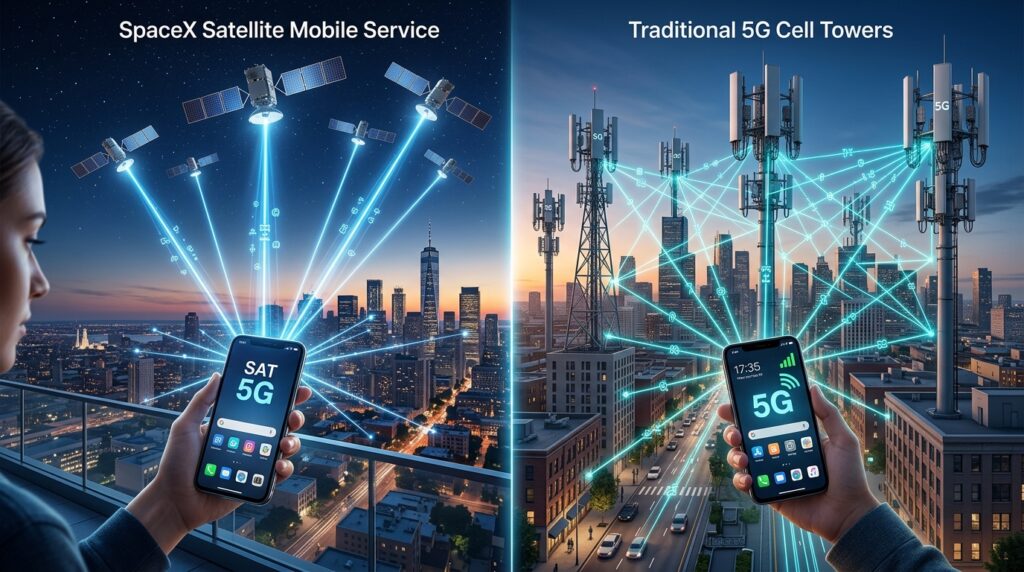
Instead of relying entirely on nearby cell towers, compatible smartphones could communicate directly with Starlink satellites orbiting Earth.
That could be especially valuable in areas such as:
- Rural communities
- Highways and remote roads
- Mountains and wilderness areas
- Offshore locations
- Disaster zones
- Areas with weak cellular infrastructure
For consumers, the biggest promise is fewer dead zones.
SpaceX also believes satellite connectivity could eventually support broader roaming capabilities, giving subscribers access to mobile service across much larger geographic areas.
SpaceX Still Hasn’t Decided How Its Ground Network Will Work
Satellite connectivity alone may not be enough for SpaceX to compete directly with AT&T, Verizon and T-Mobile.
Traditional cellular networks still have major advantages, particularly in cities, crowded environments and indoor locations.
That is why SpaceX has previously discussed creating a terrestrial component to its network.
One proposal involved placing small cellular access points alongside Starlink satellite dishes. These small cells could theoretically help SpaceX provide stronger local coverage while satellites handle broader geographic connectivity.
However, Johnsen’s latest comments suggest SpaceX is still evaluating its options.
The company could:
- Build portions of its own terrestrial network.
- Partner with existing wireless carriers.
- Operate as a mobile virtual network operator, or MVNO.
- Combine satellite and terrestrial infrastructure.
SpaceX already controls wireless spectrum acquired from EchoStar that can support both satellite and terrestrial communications in the United States.
That gives the company flexibility while it decides how aggressively it wants to compete with traditional carriers.
SpaceX vs. AT&T, Verizon and T-Mobile
The possibility of Starlink becoming a nationwide mobile provider has triggered a growing war of words between SpaceX and America’s biggest wireless companies.
Executives from AT&T, T-Mobile and Verizon have questioned whether satellite-based mobile service can truly replace traditional cellular networks.
Their main argument comes down to physics.
Cellular towers are much closer to smartphones than satellites orbiting hundreds of kilometers above Earth. Ground networks can therefore provide stronger signals, particularly inside buildings and heavily populated areas.
T-Mobile executives have argued that direct-to-cell satellite technology is better viewed as a complementary service rather than a full replacement for cellular networks.
Verizon has made a similar argument, suggesting Starlink would have difficulty competing in urban and suburban markets without significant ground infrastructure.
AT&T executives have also questioned whether scattered small-cell deployments would be enough to solve those problems.
SpaceX sees things very differently.
Johnsen argued that the traditional wireless industry has experienced relatively little innovation and believes Starlink could eventually offer something carriers struggle to match: broad geographic coverage with fewer dead zones and potentially global roaming.
Why Starship Is Critical to the Plan
SpaceX’s mobile ambitions depend heavily on Starship.
The company’s massive reusable rocket is expected to carry much larger Starlink satellites into low-Earth orbit than the Falcon 9 rockets traditionally used for Starlink launches.
SpaceX is developing next-generation V3 Starlink satellites, which are expected to provide significantly more network capacity.
The company’s upcoming direct-to-device satellites will be based on the same V3 platform.
SpaceX plans to begin launching those mobile-focused satellites as it builds the constellation required for the 2028 service.
That means Starship’s launch reliability and deployment schedule will play a major role in determining whether Starlink Mobile reaches consumers on time.
Why This Matters for Consumers
Starlink Mobile could eventually change what consumers expect from their wireless provider.
Today, switching carriers often involves comparing coverage maps, pricing, data limits and network speeds.
Satellite connectivity could introduce another factor: whether your phone can remain connected almost anywhere you travel.
Imagine driving through a rural area without losing service, hiking far beyond traditional cellular coverage or traveling internationally without relying as heavily on local roaming agreements.
That is the experience SpaceX appears to be targeting.
However, there are still major unknowns.
SpaceX has not fully explained:
- Expected mobile data speeds
- Monthly pricing
- Smartphone compatibility
- Indoor coverage
- Network capacity
- Data limits
- Carrier partnerships
- International availability
These details will ultimately determine whether Starlink becomes a true wireless competitor or simply a powerful extension of existing mobile networks.
What This Means for Wireless Carriers
For AT&T, Verizon and T-Mobile, Starlink represents both a potential threat and a potential partner.
In remote areas, satellite connectivity can help carriers extend coverage without building expensive towers.
But if SpaceX eventually offers its own nationwide mobile plans, the relationship changes.
Starlink could compete directly for subscribers.
This could force traditional carriers to improve rural coverage, lower prices, offer better roaming packages or accelerate their own satellite partnerships.
The competition could ultimately benefit consumers.
Aqyreon Take
SpaceX is not trying to build another ordinary wireless carrier.
Its biggest advantage is geography.
Traditional mobile networks depend on thousands of towers placed across the country. Starlink wants to add another layer above those networks by using thousands of satellites capable of reaching smartphones almost anywhere.
That does not mean terrestrial cellular networks are going away.
Satellite networks still face major challenges involving signal strength, indoor coverage, network capacity and latency.
The most realistic future may be a hybrid mobile network, where smartphones automatically switch between terrestrial towers and satellites depending on which connection is strongest.
If SpaceX successfully launches its next-generation satellites and delivers meaningful 5G-level performance in 2028, the biggest change may not be that Starlink replaces Verizon, AT&T or T-Mobile.
It may be that mobile dead zones become much harder to find.
Bottom Line
SpaceX is targeting the first half of 2028 for its next-generation Starlink mobile service, with the goal of offering 5G-quality connectivity directly from satellites to smartphones.
The company has the satellites, spectrum and launch infrastructure to become a significant force in mobile communications.
What it does not yet have is a clearly defined terrestrial network strategy.
Whether SpaceX builds its own ground network, partners with existing carriers or combines both approaches could determine whether Starlink becomes a powerful backup network — or one of the biggest disruptions the wireless industry has seen in decades.