The No-Design AI Side Hustle: Turn Nano Banana Images Into Sellable PDFs
Artificial intelligence is making it easier for ordinary people to create digital products without becoming professional writers, illustrators, or graphic designers.
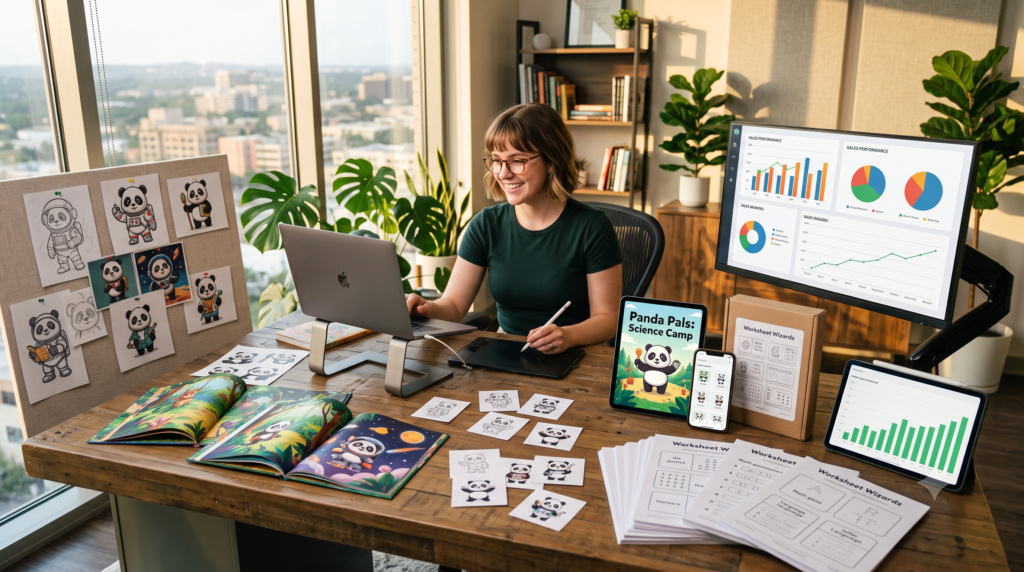
One opportunity receiving attention is the use of Nano Banana, Google’s AI image-generation technology, to create illustrated children’s books, activity books, coloring pages, worksheets, and other downloadable products.
The basic idea sounds attractive:
- Generate a story and illustrations with AI.
- arrange the pages in Canva.
- Export the finished product as a PDF.
- Upload it to a marketplace such as Etsy.
- Earn money whenever someone downloads it.
Technically, this business model is possible.
However, claims that anyone can effortlessly make $10,000, $50,000, or $100,000 every month from simple PDFs should be treated carefully. AI can reduce production time, but it does not automatically create demand, guarantee sales, or turn every digital product into passive income.
Let us break down what Nano Banana can actually do, how the digital-book business works, and what beginners need to know before jumping in.
What Is Nano Banana?
Despite its unusual name, Nano Banana is not a random third-party website or a small, unknown AI startup.
Nano Banana is the name associated with Google’s native image-generation capabilities inside the Gemini ecosystem. Google currently offers multiple Nano Banana models designed for generating, editing, and refining images through conversational instructions.
The technology can be used to create:
- Illustrated characters
- Children’s book scenes
- Product mockups
- Educational diagrams
- Posters and social-media graphics
- Coloring-book artwork
- Marketing visuals
- Branded creative assets
Newer versions, including Nano Banana 2 and Nano Banana Pro, are designed to improve image quality, prompt understanding, character consistency, editing, and the generation of readable text inside images.
That makes the tool useful for digital-product creators, especially people who previously needed to hire an illustrator for every page.

The Digital Children’s Book Opportunity
Parents, teachers, homeschoolers, caregivers, and childcare providers regularly buy downloadable educational materials.
These products can include:
- Short bedtime stories
- Personalized children’s books
- Alphabet workbooks
- Number-learning activities
- Bible activity books
- Emotional-learning stories
- Potty-training books
- Coloring pages
- Travel activity packs
- Printable flashcards
- Classroom worksheets
- Children’s journals
Because these products are delivered digitally, the seller does not need to hold inventory, package orders, or pay for shipping.
Once the product has been created and uploaded, customers can purchase and download it automatically.
That is where the “passive income” description comes from.
However, the income is only passive after the seller has completed the less-passive work of researching the market, developing the product, checking its quality, creating the listing, promoting it, answering customers, and improving underperforming products.
How the Nano Banana PDF Business Works
The process can be divided into five major stages.
Step 1: Choose a Specific Book Idea
Do not begin by asking AI to create a random children’s book.
Start with a specific customer, problem, age group, and outcome.
A weak idea would be:
Create a children’s book about a panda.
A stronger idea would be:
Create a 12-page bedtime story for children ages four to seven about a shy panda learning how to make friends on the first day of school.
The second idea has a clear audience and emotional purpose.
Other potentially useful concepts include:
- A story that teaches children how to manage anger
- A book about preparing for the first day of school
- A bedtime story for children afraid of the dark
- A workbook that teaches basic addition
- A personalized birthday adventure
- A story that teaches kindness and sharing
- An activity book for long car journeys
- A hygiene and handwashing story
- A book about welcoming a new sibling
- A children’s guide to saving money
Specific products are usually easier to market than generic products because the listing can speak directly to a recognizable customer need.

Step 2: Create the Story Before the Images
One of the biggest mistakes beginners make is generating attractive pictures before developing the complete story.
Start with the written structure.
You can use ChatGPT or another writing assistant to create:
- The title
- The main character
- The lesson or theme
- A page-by-page outline
- Narration for each page
- Illustration instructions
- A short product description
For example:
Write a 12-page children’s story for ages four to seven about a young panda who is nervous about starting school. Use fewer than 45 words per page, simple vocabulary, a reassuring tone, and a positive ending. After each page, provide a detailed illustration prompt.
Do not publish the first response without reviewing it.
Check for:
- Awkward sentences
- Repetitive language
- Age-inappropriate vocabulary
- Contradictions
- Weak story structure
- Incorrect information
- Frightening or unsuitable scenes
- Grammar and spelling errors
AI should function as your creative assistant—not as an unsupervised publisher.
Step 3: Generate Consistent Illustrations
After the story is complete, use Nano Banana to produce the images.
Consistency matters greatly in children’s books. The panda on page one should not suddenly have different clothing, facial features, colors, or proportions on page six.
Create a detailed character description before generating the first page.
For example:
A small, friendly panda named Piko with round brown eyes, a blue backpack, a yellow scarf, short legs, soft watercolor-style fur, and a warm, expressive face. Maintain exactly the same character design across every illustration.
Then create each scene individually.
A page prompt could say:
Create a square children’s book illustration of Piko, the small panda with round brown eyes, a blue backpack, and a yellow scarf, standing nervously outside a colorful elementary school. Other young animal students are entering the building. Warm morning light, gentle watercolor storybook style, cheerful but slightly emotional atmosphere, clean composition, no text.
Google recommends using detailed prompts that describe the subject, setting, composition, action, and visual style. Greater specificity generally gives the creator more control over the final image.
Generate the illustrations one page at a time rather than asking for an entire finished book in a single image.
This gives you more control over:
- Page dimensions
- Character consistency
- Text placement
- Story accuracy
- Image corrections
- Print quality
Step 4: Assemble the Book in Canva
Once the illustrations are ready, move them into Canva or another design platform.
Canva provides templates for storybooks, workbooks, presentations, worksheets, and square-format publications.
A simple workflow would be:
- Create a new design using your chosen page dimensions.
- Add a cover page.
- Upload the AI-generated illustrations.
- Place one illustration on each page.
- Add the story text separately.
- Use large, readable fonts.
- Leave enough space around the text.
- Add a copyright and usage page.
- Proofread the entire book.
- Export it as a high-quality PDF.
It is usually better to add the final text in Canva rather than permanently embedding long paragraphs inside the generated images.
Editable text is easier to correct and is generally more readable.
Before exporting, examine the book at 100% zoom and make sure:
- Nothing is cut off.
- The font is readable.
- The pages follow the correct order.
- The illustrations are sharp.
- The character remains consistent.
- There are no strange hands, eyes, limbs, or background objects.
- The wording does not contain AI-generated mistakes.

Step 5: Create a Strong Product Listing
A good product can remain invisible if the listing is poorly written.
Your title and description should clearly explain:
- What the product is
- Who it is for
- What the customer receives
- The file format
- How many pages are included
- Whether it is printable
- Whether it is editable
- Whether it is a physical or digital item
- How the customer can use it
A possible Etsy title could be:
First Day of School Panda Storybook PDF, Printable Kids’ Anxiety Book, Social Emotional Learning Story for Ages 4–7
The product description should immediately clarify that it is a digital download.
For example:
Help young children feel more confident about starting school with this gentle printable story about Piko the panda. This 12-page digital book introduces common first-day worries through colorful illustrations, simple language, and a reassuring ending.
Never make customers search through the listing to discover that no physical book will be shipped.
Can You Sell AI-Generated Books on Etsy?
Etsy permits seller-prompted AI creations, but sellers must still meet the platform’s creativity requirements.
Etsy says digital products must be made or designed by the seller. Its current guidance also states that seller-prompted AI creations must disclose the use of AI.
That means you should not simply download an image generated by someone else, place it in a bundle, and present it as your original creative work.
Your role should include meaningful creative decisions such as:
- Developing the concept
- Writing or editing the story
- Creating the prompts
- Selecting and refining the artwork
- Designing the pages
- Formatting the product
- Proofreading the content
- Creating the final customer experience
You should also disclose the use of AI in the appropriate part of the listing.

What About Amazon KDP?
Amazon KDP can be used to publish ebooks and printed books, but its workflow is different from selling a downloadable PDF on Etsy.
Amazon distinguishes between AI-generated content and AI-assisted content.
According to Amazon’s current content guidelines, publishers must disclose AI-generated text, images, or translations when submitting or republishing a book. AI-assisted content does not require the same disclosure.
If Nano Banana creates the interior illustrations or cover images, those would generally fall under Amazon’s definition of AI-generated images.
You must also ensure that the book complies with Amazon’s quality, intellectual-property, metadata, and customer-experience standards.
Uploading hundreds of poorly reviewed, repetitive AI books is not a reliable long-term strategy. Low-quality books can lead to negative reviews, refunds, poor rankings, or platform enforcement.
The Copyright Problem Beginners Often Ignore
AI makes it easy to create characters that resemble popular franchises.
That does not mean you are allowed to sell them.
Avoid products involving recognizable copyrighted or trademarked properties such as:
- Disney characters
- Marvel superheroes
- Pokémon
- Bluey
- Paw Patrol
- Barbie
- Minecraft
- Harry Potter
- Famous sports-team logos
- Celebrity likenesses
Writing “inspired by” in the description does not automatically make the product legal.
Build original characters, original worlds, and original branding.
You should also review the commercial-use terms of every AI tool, font, Canva element, stock image, and template included in your product.
Can This Really Make $10,000 a Month?
It is possible for successful digital-product shops to generate significant revenue.
However, a statement such as “anyone can easily make $10,000 per month” leaves out several important factors:
- Product demand
- Market competition
- Pricing
- Advertising costs
- Marketplace fees
- Refunds
- Conversion rates
- Customer reviews
- Copyright compliance
- Shop age and authority
- Seasonal demand
- Product quality
- The seller’s marketing ability
Revenue is also not the same as profit.
A shop generating $10,000 in monthly sales may still pay for:
- Marketplace fees
- Advertising
- AI subscriptions
- Design software
- Keyword-research tools
- Contractors
- Taxes
- Customer refunds
- Business expenses
The best way to approach this opportunity is not to expect an instant “money printer.”
Treat it as a real digital-publishing business.
A More Realistic Beginner Strategy
Instead of creating 100 generic books, begin with one tightly defined niche.
For example, you could build a small collection around children’s emotional development:
- A story about starting school
- A book about controlling anger
- A story about making friends
- A book about dealing with mistakes
- A bedtime anxiety workbook
This gives your shop a recognizable theme.
You can then create bundles, such as:
Five Printable Social-Emotional Storybooks for Children Ages Four to Seven
A focused collection may look more credible than a store containing unrelated dinosaur books, wedding planners, business spreadsheets, religious worksheets, and recipe cards.

How to Research a Niche Before Creating Anything
Go to Etsy and search for the product you are considering.
Study:
- The autocomplete suggestions
- The number of competing listings
- The design styles on the first page
- Common prices
- Customer reviews
- Complaints in lower-rated reviews
- Product formats
- Page counts
- Age groups
- Themes customers repeatedly request
Do not copy another seller’s story, artwork, title, description, or product layout.
Use the research to identify gaps.
For example, customers may like a particular product but complain that:
- The pages are difficult to print.
- The illustrations are not diverse.
- The text is too small.
- The story is too long.
- The download instructions are confusing.
- The product does not include a low-ink version.
- The activity is unsuitable for younger children.
Those complaints can help you build a better product.
Digital Product Ideas Beyond Children’s Storybooks
Nano Banana can also support other visual PDF businesses.
Possibilities include:
- Printable coloring books
- Children’s chore charts
- Classroom posters
- Flashcards
- Homeschool worksheets
- Wedding activity books for children
- Baby-shower games
- Printable puzzles
- Travel journals
- Meal-planning templates
- Visual social stories
- Language-learning cards
- Goal-setting workbooks
- Business checklists
- Real-estate guides
- Employee training materials
The strongest products normally solve a particular problem or save the buyer time.
A Simple Production Workflow
Here is the complete process:
Stage One: Research
Choose a clear customer and search for proven demand.
Stage Two: Write
Develop the story, lesson, page structure, and text.
Stage Three: Illustrate
Use Nano Banana to create original, consistent artwork.
Stage Four: Design
Arrange the images and editable text in Canva.
Stage Five: Review
Check spelling, image quality, page order, facts, safety, and licensing.
Stage Six: Export
Create the final PDF and a smaller sample or preview file.
Stage Seven: List
Write a search-friendly title, description, tags, and customer instructions.
Stage Eight: Promote
Use Pinterest, Instagram, Facebook, YouTube Shorts, blogging, email marketing, or Etsy Ads to attract visitors.
Stage Nine: Improve
Study views, clicks, favorites, conversions, reviews, and customer questions.
Stage Ten: Expand
Create related products based on what customers actually buy.
Example Nano Banana Prompt
Here is a prompt structure you can adapt:
Create a square children’s storybook illustration for ages four to seven. Show a friendly young panda named Piko with round brown eyes, a yellow scarf, a blue backpack, and a small tuft of fur on his head. Piko is entering a bright elementary-school classroom and being welcomed by a smiling rabbit teacher. Include colorful bookshelves, alphabet decorations, tiny desks, and warm morning sunlight. Gentle watercolor-and-gouache illustration, expressive characters, soft edges, professional children’s publishing quality, consistent character proportions, uncluttered composition, no text, no logos, no copyrighted characters.
Save your main character description and repeat it in every page prompt.
How ChatGPT Can Help With the Listing
After creating the product, you can ask ChatGPT:
Write an Etsy title, description, 13 search tags, image-alt text, and five listing-image captions for a 12-page printable children’s story about overcoming first-day-of-school anxiety. The target customer is a parent, teacher, counselor, or homeschooler buying for children ages four to seven. Clearly state that this is a digital PDF and no physical item will be shipped. Avoid exaggerated claims and keyword stuffing.
Review the output and adjust it to accurately match the product.
Do not include keywords for features your product does not contain.
What Aqyreon Readers Should Learn From This
Nano Banana can lower the cost of entering the digital-publishing market.
Someone who previously could not afford an illustrator may now be able to produce an early prototype, test an idea, or create an original visual product.
But the real opportunity is not simply “AI creates a PDF.”
The opportunity comes from combining:
- Useful market research
- Original ideas
- Strong storytelling
- Consistent illustrations
- Good design
- Search optimization
- Honest marketing
- Platform compliance
- Continuous improvement
AI makes production faster. It does not remove the need for creativity, judgment, quality control, or business strategy.
Final Verdict
Nano Banana is a powerful creative tool, but calling it an automatic money printer is misleading.
You can use it to create sellable digital books, illustrations, worksheets, and other visual products. Etsy currently allows seller-prompted AI creations when sellers follow its creativity and disclosure requirements, while Amazon KDP requires publishers to identify AI-generated content during submission.
The barrier to creating digital products is becoming lower.
At the same time, competition is becoming higher.
The people most likely to succeed will not be those who generate the largest number of generic PDFs. They will be the creators who understand a specific audience, produce genuinely useful products, develop original brands, and maintain a level of quality that customers are willing to recommend.
Start with one focused product.
Publish it responsibly.
Study the response.
Then improve and expand based on real customer demand—not viral income promises.
Aqyreon takeaway: Nano Banana can help you build digital products faster, but the money comes from solving a problem and earning customer trust—not merely pressing the generate button.