Hisense vs TCL vs Samsung vs Vizio: Which 98- to 100-Inch TV Is Actually Worth Buying?
Buying a 98- or 100-inch TV sounds exciting until you realize that screen size is only part of the story.
At this size, small differences in brightness, motion handling, black levels, smart-TV software, and picture processing become much more noticeable. A TV that looks decent at 55 inches can expose every weakness when stretched across a screen nearly nine feet wide.
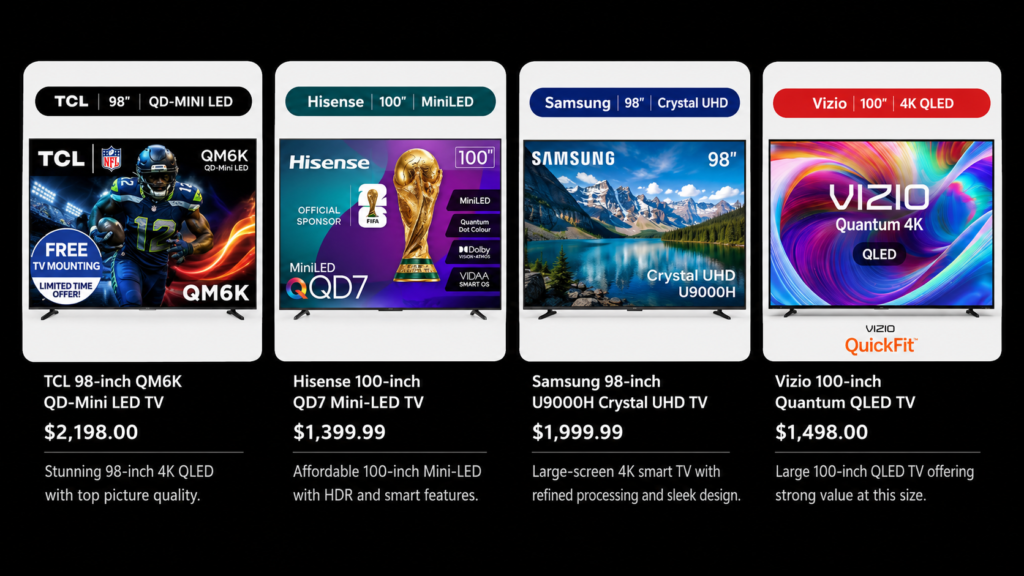
We compared four popular big-screen options:
- Hisense QLED QD7 Series — 100 inches
- TCL 98QM6K — 98 inches
- Samsung Crystal UHD U9000H — 98 inches
- Vizio 100 Quantum TV — 100 inches
Based on display technology, gaming features, everyday usability, and buyer feedback, one model stands out as the strongest overall choice.
The Quick Verdict
The TCL 98QM6K is the best overall TV in this comparison.
It offers the strongest combination of Mini-LED contrast, QLED color, 144Hz motion, gaming performance, Dolby Vision support, and overall picture quality.
The Hisense QD7 is the best value alternative, especially when it is significantly cheaper than the TCL.
The Samsung U9000H is better suited to buyers who prioritize processing, upscaling, brand familiarity, and a polished smart-TV experience.
The Vizio 100 Quantum is mainly worth considering when price matters more than premium motion or gaming performance.
Let’s break them down.
1. TCL 98QM6K: Best Overall Picture and Performance
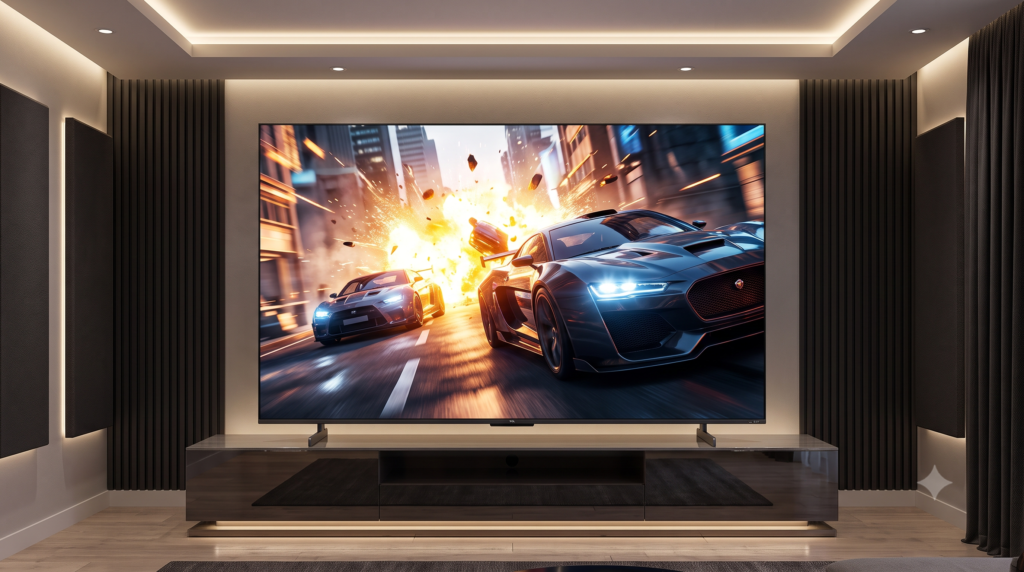
The TCL 98QM6K is the strongest all-rounder of the four.
It uses QD Mini-LED technology, combining quantum-dot color with smaller and more precise LED backlights. This allows the TV to produce brighter highlights, deeper blacks, stronger contrast, and more convincing HDR performance than a standard LED television.
The result is a picture that looks more cinematic, especially when watching movies in a dark room.
Why the TCL stands out
The TCL includes:
- 98-inch QD Mini-LED display
- Native 144Hz refresh rate
- Local dimming
- Dolby Vision
- HDR10+
- TCL AIPQ Pro processor
- Google TV
- Strong gaming support
For sports and gaming, the 144Hz refresh rate helps fast-moving scenes look smoother. Gamers using a modern console or gaming PC will also benefit from features such as variable refresh rate and lower input lag.
Buyer feedback commonly highlights the TV’s brightness, sharpness, color quality, black levels, and smooth motion.
Where it falls short
The TCL is not perfect.
Some buyers report occasional blooming around bright objects, especially white subtitles on dark backgrounds. Google TV can also feel slow at times, depending on how many apps are installed.
The picture may also need some adjustment out of the box. Many televisions ship with overly bright or artificial-looking picture settings designed for store displays.
Who should buy it?
Choose the TCL if you want the best combination of:
- Movie performance
- Sports viewing
- Gaming
- HDR brightness
- Deep black levels
- Overall value
For most buyers, this is the best TV of the group.
2. Hisense QLED QD7 Series: Best Value for a Full 100-Inch Screen
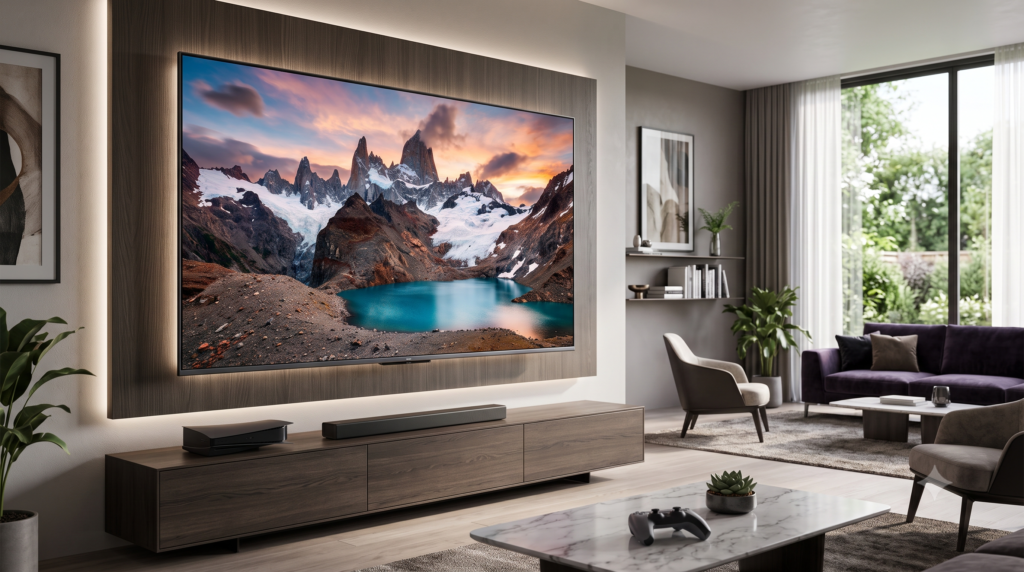
The Hisense QD7 is the closest competitor to the TCL.
It offers a full 100-inch screen, quantum-dot color, Mini-LED backlighting, and a native 144Hz refresh rate. On paper, that makes it one of the most attractive big-screen televisions for the money.
Main features
The Hisense offers:
- 100-inch QLED Mini-LED display
- Native 144Hz gaming support
- Dolby Vision
- Dolby Atmos
- HDR10+
- Variable refresh rate
- Fire TV platform
- Two-year manufacturer warranty
The Hisense can deliver vivid colors, smooth gaming, and an immersive movie experience without reaching the price level of more premium 100-inch televisions.
It is especially appealing when heavily discounted.
What does “glare-free” really mean?
Hisense marketing may describe the TV as glare-resistant or glare-reducing.
That does not mean reflections completely disappear.
In a room with large windows or direct sunlight, you may still see reflections on the screen. Premium anti-glare coatings are usually found on more expensive televisions.
The Hisense may handle reflections reasonably well, but buyers should not expect the same result as a specialized matte-display TV.
What buyers like
Owners often praise:
- The huge screen
- Bright and vibrant color
- Strong gaming performance
- Easy streaming access
- Good value for the size
Common concerns
Some buyers and reviewers point to:
-

Uneven screen uniformity
- Blooming around bright objects
- Fire TV advertisements
- Inconsistent quality control
- Lower-quality streaming content looking rough
This last point matters.
A 100-inch TV can expose flaws in old movies, low-resolution cable channels, and heavily compressed YouTube videos. The larger the screen, the more important good image processing becomes.
Who should buy it?
Choose the Hisense when it costs several hundred dollars less than the TCL.
If both TVs are priced closely, the TCL is the safer overall choice. If the Hisense is heavily discounted, it becomes one of the best-value large TVs available.
3. Samsung Crystal UHD U9000H: Best for Processing and Everyday Simplicity
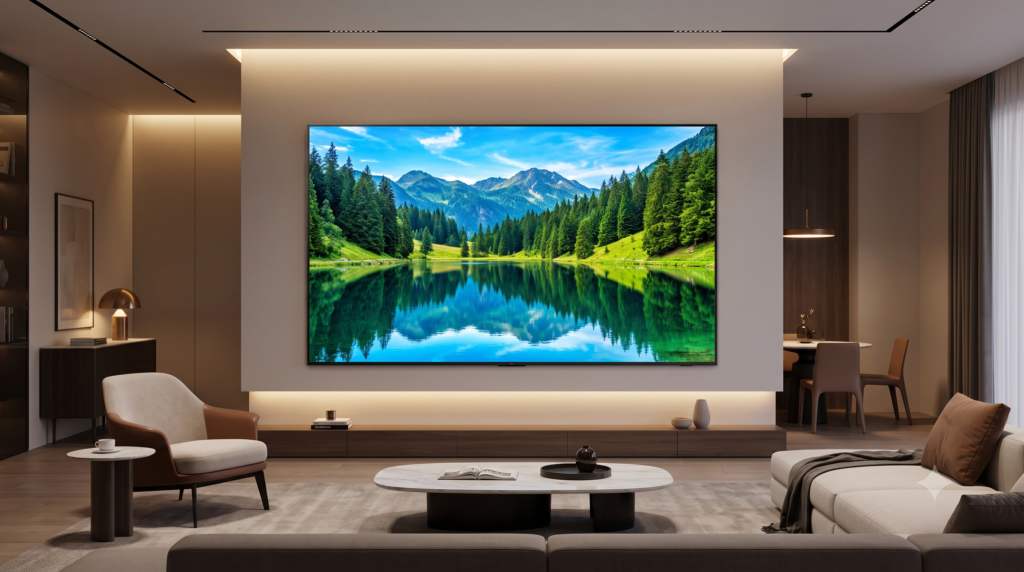
The Samsung U9000H takes a different approach.
Unlike the TCL and Hisense, it does not use Mini-LED technology. It is a standard Crystal UHD LED television.
That means it may not deliver the same deep blacks, intense brightness, or premium HDR performance.
However, Samsung’s main advantage is image processing.
Main features
The Samsung includes:
- 98-inch Crystal UHD display
- NQ4 AI Gen 2 processor
- 4K AI upscaling
- Supersize Picture Enhancer
- Motion Xcelerator 144Hz
- HDR10+
- Tizen smart platform
- Samsung Gaming Hub
The NQ4 AI Gen 2 processor is designed to improve lower-resolution content and sharpen the image.
This can make the Samsung a better option for viewers who watch a lot of:
- Cable television
- Older movies
- 1080p content
- Live news
- Lower-quality streaming video
Samsung’s Tizen interface is also familiar, polished, and easy to navigate.

The biggest disadvantages
The Samsung does not offer:
- Mini-LED backlighting
- Quantum-dot color
- Dolby Vision
Samsung supports HDR10+, but the lack of Dolby Vision may matter to movie fans who use streaming services and Blu-ray content that support Dolby Vision.
The TV also has weaker black-level performance than the TCL and Hisense.
What about buyer reviews?
Because the U9000H is a newer model, long-term buyer feedback is still more limited than with older televisions.
Early reviews may look very positive, but a small review sample should not automatically be treated as proof of superior reliability.
Who should buy it?
Choose the Samsung if you care more about:
- Clean upscaling
- Easy smart-TV navigation
- Samsung ecosystem integration
- Cable and everyday television
- Brand familiarity
It is a polished TV, but it is not the strongest option for premium home-theater picture quality.
4. Vizio 100 Quantum TV: Best for Buyers Focused Mainly on Price
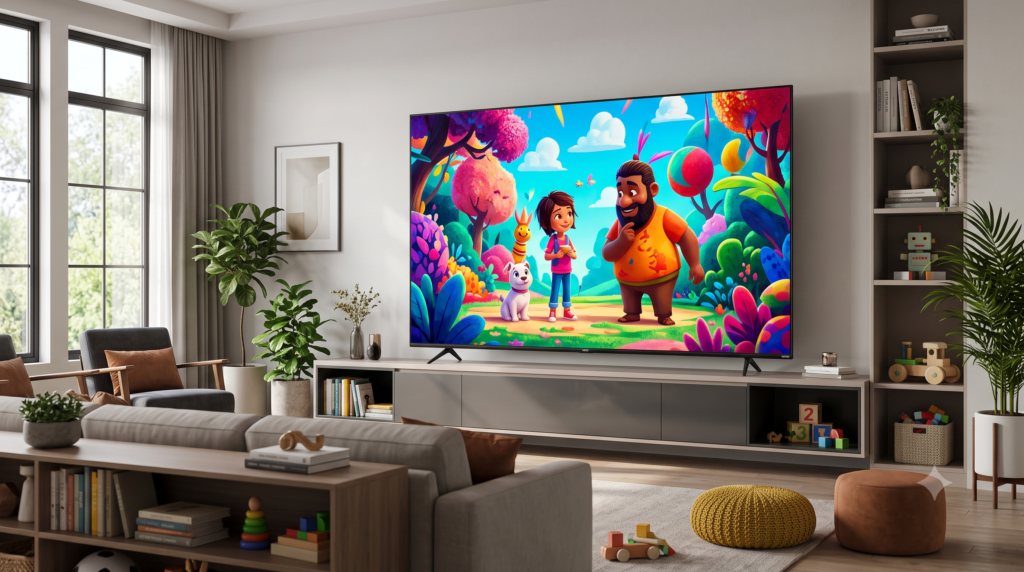
The Vizio 100 Quantum delivers one thing very well: a huge screen at a lower price.
It uses quantum-dot color and supports popular HDR formats, making it more colorful than a basic LED television.
However, it has one major limitation.
The refresh-rate problem
The Vizio has a native 60Hz panel.
Some marketing language may mention motion rates above 60, but those numbers are not the same as a true native 120Hz or 144Hz refresh rate.
This means the Vizio is less suitable for:
- High-refresh-rate gaming
- 4K gaming at 120 frames per second
- Fast sports
- Buyers sensitive to motion blur
- PC gaming above 60Hz
Main features
The Vizio offers:
- 100-inch 4K QLED display
- Dolby Vision
- HDR10+
- Quantum-dot color
- Full-array LED backlighting
- Wi-Fi 6
- Smart-TV streaming features
What buyers like
Owners often mention:
- The huge screen
- Strong value
- Bright colors
- Easy access to streaming
- Impressive size for the price
Common complaints
Reported concerns include:
- Software bugs
- Slow smart-TV performance
- Remote-control issues
- Weak upscaling
- Inconsistent long-term reliability
- Quality-control problems

Who should buy it?
Choose the Vizio only when it is substantially cheaper than the TCL and Hisense.
It works best for casual television, movies, and streaming. Serious gamers and sports fans should consider one of the 144Hz models instead.
Side-by-Side Comparison
| Feature | TCL 98QM6K | Hisense QD7 100” | Samsung U9000H 98” | Vizio Quantum 100” |
|---|---|---|---|---|
| Display technology | QD Mini-LED | QLED Mini-LED | Crystal UHD LED | QLED LED |
| Screen size | 98 inches | 100 inches | 98 inches | 100 inches |
| Native refresh rate | 144Hz | 144Hz | Up to 144Hz gaming support | 60Hz |
| Dolby Vision | Yes | Yes | No | Yes |
| HDR10+ | Yes | Yes | Yes | Yes |
| Smart platform | Google TV | Fire TV | Tizen | Vizio OS |
| Gaming performance | Excellent | Very good | Very good | Basic |
| Dark-room movies | Excellent | Very good | Average | Average |
| Upscaling | Good | Fair to good | Excellent | Below average |
| Best use | Movies, gaming and sports | Best-value big screen | Cable and everyday viewing | Budget casual viewing |
Which TV Is Best for Gaming?
The TCL 98QM6K is the best gaming TV in this comparison.
It combines a native 144Hz refresh rate, Mini-LED contrast, low input lag, strong HDR, and modern gaming features.
The Hisense QD7 is also a strong gaming option, particularly if it is cheaper.
The Samsung can handle high-refresh-rate gaming, but its weaker contrast and lack of Dolby Vision reduce its home-theater advantage.
The Vizio is the weakest gaming choice because of its native 60Hz panel.
Which TV Is Best for Movies?
The TCL is the best option for movies.
Mini-LED backlighting helps it display darker scenes with better contrast, while Dolby Vision improves supported HDR content.
The Hisense is a close second.
Samsung may produce a clean image, but it cannot match the same black levels or Dolby Vision support.
The Vizio offers a large cinematic screen, but its weaker processing and backlight performance limit the experience.
Which TV Is Best for Sports?
The TCL and Hisense are the strongest sports choices because of their 144Hz panels.
Fast action should appear smoother, especially during football, basketball, hockey, and soccer.
The Samsung may also perform well because of its processing and motion handling.
The Vizio is acceptable for casual sports viewing, but motion may look less smooth than on the other three.

Important Buying Advice Before Ordering a 100-Inch TV
Buying the TV is only part of the cost.
Large televisions require more planning than standard 55- or 65-inch models.
Measure the room
A 100-inch 16:9 television is approximately 87 inches wide before including the bezel.
Make sure:
- The wall is wide enough
- The television can fit through doors
- Hallways have enough turning space
- Stairs can accommodate the box
- The media cabinet is wide and strong enough
A practical viewing distance is around 9 to 13 feet.
Sitting too close may make low-quality content look worse.
Use professional installation
These TVs can weigh well over 100 pounds.
A 100-inch panel can also flex and crack if handled incorrectly.
Use:
- A mount rated for the TV’s exact weight
- Proper wall studs or reinforced backing
- At least three experienced installers
- Professional cable routing
- A secure mounting system
Do not rely on a cheap universal wall mount.
Inspect it immediately
Large televisions face a greater risk of shipping damage.
Before the return window closes, test for:
- Dead pixels
- Vertical lines
- Cracked corners
- Uneven brightness
- Dirty-screen effect
- Excessive blooming
- Wi-Fi issues
- HDMI problems
- Audio synchronization
- Remote-control failures
Sports content with a bright field is useful for spotting screen uniformity problems.
Consider an extended warranty
An extended warranty may be more useful on a 100-inch TV because repairs and transportation can be complicated.
Check whether the warranty includes:
- In-home service
- Panel replacement
- Power-board failure
- Dead-pixel coverage
- Removal and reinstallation
- Full replacement when repair is impossible
A manufacturer’s two-year warranty may sound good, but the details matter.
Final Aqyreon Recommendation
The TCL 98QM6K is the best overall choice.
It offers the strongest picture technology, excellent gaming performance, deep contrast, strong HDR, and a better balance of premium features.
Choose the Hisense QD7 when it is significantly cheaper and you still want Mini-LED, QLED color, and 144Hz gaming.
Choose the Samsung U9000H when image processing, cable television, Tizen, and everyday simplicity matter more than premium contrast.
Choose the Vizio 100 Quantum only when it is heavily discounted and your main goal is getting the biggest screen for the lowest price.
Bottom Line
Do not buy a 100-inch TV based only on screen size.
At this level, display technology matters.
A 98-inch Mini-LED TV with better processing and contrast can deliver a more impressive experience than a weaker 100-inch model.
For most buyers, the TCL offers the best balance of size, performance, and long-term value.