
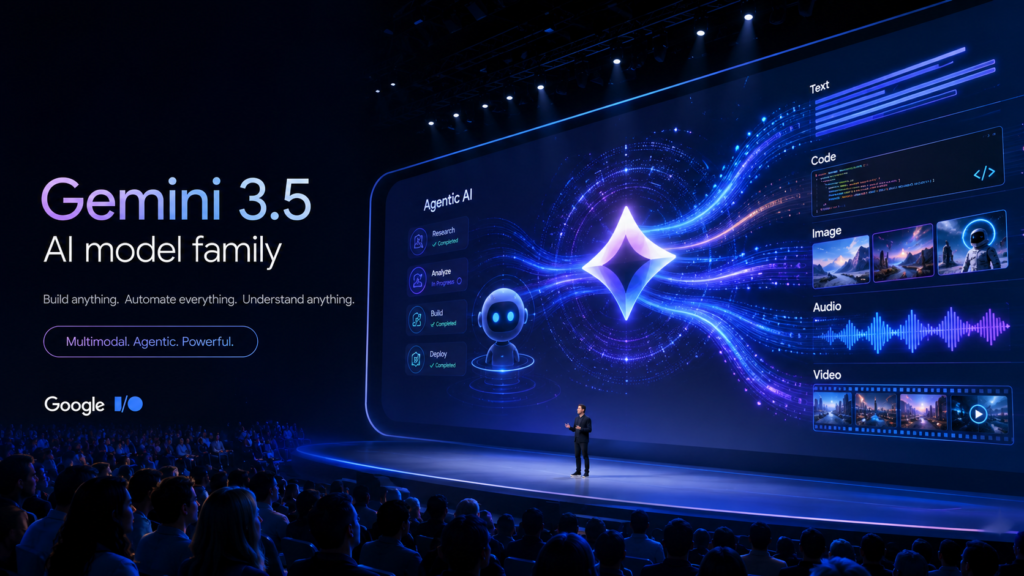
Google Gemini 3.5 Is Here: Why Google’s New AI Model Family Could Change the AI Race Again
Google Is No Longer Playing Defense in AI
For a long time, Google looked like the company that had the research, the data, the cloud infrastructure, and the talent — but somehow allowed OpenAI to own the public AI conversation first.
ChatGPT changed the internet in 2022. Anthropic became the serious enterprise AI alternative. Microsoft used its OpenAI relationship to push AI deep into productivity software.
But Google is now trying to flip the story.
At Google I/O 2026, the company introduced its newest AI model family: Gemini 3.5. The first model in the family is Gemini 3.5 Flash, with Gemini 3.5 Pro expected next month. Google is positioning Flash as a fast, powerful, agent-ready model designed for coding, automation, and everyday AI workflows. Google Cloud says Gemini 3.5 Flash is rolling out now, while Gemini 3.5 Pro is currently in testing and expected next month.
This is not just another AI model announcement.
This is Google telling the market: AI is no longer just about answering questions. It is about doing work.
What Is Gemini 3.5?
Gemini 3.5 is Google’s newest AI model family designed to power the next stage of AI products across Google’s ecosystem.
The first model, Gemini 3.5 Flash, is built around speed, coding ability, and agentic performance. In simple terms, that means it is designed not only to respond to prompts, but also to help complete multi-step tasks.
That matters because the next phase of AI is moving beyond chatbots.
Businesses do not just want an AI that can explain a spreadsheet. They want an AI that can analyze the spreadsheet, generate a report, draft the email, create a plan, and possibly trigger the next workflow.
That is the real meaning of Gemini 3.5.
It is Google’s push toward AI that can act like a digital worker.
Why Gemini 3.5 Flash Matters
Gemini 3.5 Flash is important because it appears to target three areas where AI adoption is growing fast:
- Speed
- Coding
- AI agents
Google is presenting Flash as a model that can deliver strong intelligence while keeping response times faster and costs more practical. That is a major business angle because companies do not only care about which model is smartest. They care about which model can run reliably, quickly, and affordably at scale.
For developers, the bigger story is coding.
If Gemini 3.5 Flash can help build, debug, automate, and coordinate software tasks more effectively, then Google is going after one of the most valuable AI markets: developer productivity.
This is where OpenAI, Anthropic, GitHub Copilot, Cursor, Replit, and other AI coding tools are already competing aggressively.
Google does not want Gemini to be viewed as just another chatbot. It wants Gemini to become part of the software-building process.
The Rise of Agentic AI: Why This Announcement Is Bigger Than Chat
The phrase “agentic AI” sounds technical, but the idea is simple.
A normal chatbot waits for you to ask questions.
An AI agent can take a goal and work through steps.
For example, instead of saying:
“Write me a business plan.”
An AI agent could eventually help:
Research the market, compare competitors, build a financial model, draft a pitch deck outline, create emails, and organize the workflow.
That is why Google’s Gemini 3.5 announcement matters.
Google is not just trying to win the “best chatbot” race. It is trying to build AI that becomes part of Search, Gmail, Docs, Chrome, Android, Workspace, cloud tools, and developer platforms.
Google’s own I/O messaging described this as the “agentic Gemini era,” highlighting new agents and tools such as Gemini Spark and broader Gemini integration across Google products.
For businesses, this means AI may soon become less of a separate tool and more of an invisible layer inside everyday software.
Gemini Spark: Google’s Push Toward Personal AI Agents
One of the biggest pieces of the announcement is Gemini Spark, Google’s new AI agent.
Based on Google I/O coverage, Gemini Spark is designed to help users complete tasks across apps and workflows, including things like writing emails, planning events, and working with Google tools. 9to5Google reported that Gemini Spark is coming first to Google AI Ultra subscribers in beta and is powered by Gemini 3.5 Flash and Google Antigravity.
This is important because Google has a massive advantage that many AI startups do not have: distribution.
Google owns or operates products people already use every day:
Google Search. Gmail. YouTube. Chrome. Android. Google Docs. Google Drive. Google Calendar. Google Photos.
If Gemini becomes deeply embedded into these products, users may not need to “go to AI.” AI will simply appear inside the tools they already use.
That is a powerful business advantage.
Gemini Omni: Google Wants the Future of AI Video Too
Google also announced Gemini Omni, a model focused on multimodal video generation and editing.
The key idea is that users may be able to generate high-quality videos using text, images, audio, and other videos — then edit those videos through natural conversation.
This matters because AI video is becoming one of the biggest battlegrounds in the creator economy.
If Gemini Omni becomes powerful, Google could compete directly in AI video creation, YouTube content production, advertising, education, social media content, and product demos.
For creators, this could reduce the gap between idea and finished video.
For businesses, this could reduce the cost of marketing content.
Instead of hiring a full team for every simple promotional video, a small business may eventually be able to use AI to create product explainers, training videos, ad creatives, and social content faster.
That does not mean human creativity disappears. It means the production bottleneck gets smaller.
Why Google Is Becoming More Dangerous in the AI Race
Google’s biggest advantage is not just its AI models.
It is the combination of:
Search + Android + YouTube + Workspace + Cloud + Gemini + AI agents
That creates an ecosystem advantage.
OpenAI has strong brand recognition and a first-mover advantage from ChatGPT. Anthropic has built trust with many enterprise users. But Google has distribution at a scale few companies can match.
If Gemini 3.5 becomes good enough, Google does not need every user to download a new app. It can place Gemini inside the products people already use.
That is why the competition is shifting.
The AI race is no longer only about who has the smartest model.
It is about who can turn AI into daily behavior.
What This Means for Businesses
For businesses, Gemini 3.5 sends a clear message: AI adoption is moving from optional to operational.
Companies that only use AI for content writing may fall behind companies that use AI for workflow automation.
Here is what business owners should pay attention to:
1. AI Agents Will Change Productivity
The next wave of AI tools will not just answer questions. They will complete tasks.
That means businesses should start identifying repetitive workflows that could be partially automated.
Examples include customer support summaries, lead research, proposal drafting, internal reporting, meeting notes, content planning, and data analysis.
2. Coding Will Become Faster
If Gemini 3.5 Flash performs strongly in coding workflows, it could help developers move faster.
Small startups may be able to build prototypes faster. Solo founders may be able to test ideas without hiring a full engineering team immediately. Agencies may deliver client projects more efficiently.
This is where tools like AI coding assistants, cloud platforms, website builders, and developer tools can become affiliate opportunities for tech blogs.
3. AI Video Will Become a Business Asset
Gemini Omni shows that AI video is becoming a serious category.
Businesses should begin thinking about how AI-generated video can support marketing, onboarding, training, sales, and education.
A small business that cannot afford a full production team may soon be able to create decent video content with AI-assisted workflows.
4. Google’s Ecosystem May Become Harder to Ignore
If Gemini becomes more deeply connected to Search, Workspace, Android, Chrome, and YouTube, businesses that already operate inside Google’s ecosystem may have a productivity advantage.
This could make Google AI plans more attractive for creators, agencies, developers, and teams that rely heavily on Google tools.
The Pricing Strategy: Google Wants More People Inside Its AI Stack
Google also announced updated pricing options for its AI services.
Google’s official subscription update introduced a $100 per month AI Ultra plan and described new features for Google AI Plus, Pro, and Ultra subscribers.
Google’s AI plan page also describes Ultra as giving users higher-level access to Google AI features, including expanded access across Gemini, Flow, AI Studio, NotebookLM, storage, and other benefits depending on the plan.
This is a smart move.
AI companies are not just competing on intelligence anymore. They are competing on price, access, limits, speed, ecosystem, and usefulness.
For creators and developers, a $100/month tier may still feel expensive. But for advanced users, agencies, developers, and teams producing content or building tools, the pricing could be positioned as a business productivity expense.
The real question is not “Is it cheap?”
The real question is:
Can it save enough time or create enough output to justify the cost?
That is how businesses should evaluate AI subscriptions.
Aqyreon Take: The AI Race Is Becoming an Ecosystem War
The Gemini 3.5 announcement shows where the AI industry is heading.
The winners may not only be the companies with the most impressive model benchmarks. The winners may be the companies that can put AI directly into daily workflows.
That is why Google is dangerous.
It has the products. It has the cloud. It has the data infrastructure. It has the mobile operating system. It has Search. It has YouTube. And now it is making Gemini more agentic, more multimodal, and more useful.
For creators, this could mean faster content production.
For developers, this could mean faster coding and automation.
For small businesses, this could mean cheaper access to tools that once required large teams.
For enterprises, this could mean AI agents that operate inside real workflows.
The biggest lesson is simple:
AI is moving from “ask me anything” to “let me help you get this done.”
That is the shift every business owner, creator, and tech professional should be watching.
Disclaimer: The image used on this post is AI-generated editorial concept. Not an official brand image.