
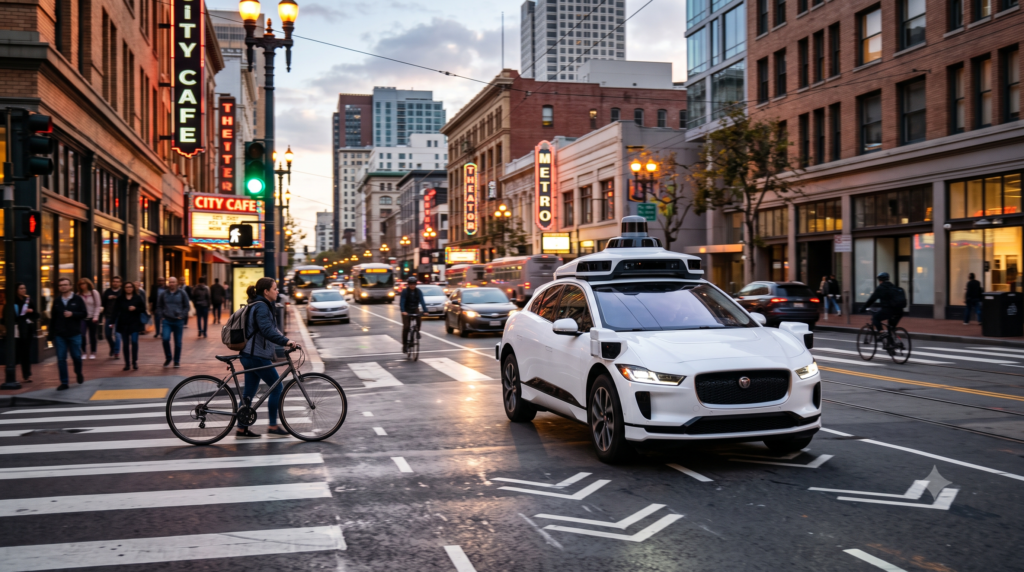
Waymo’s CEO Warns AI Developers: In the Physical World, One Mistake Can Cost a Life
Silicon Valley has long celebrated the idea of moving quickly, launching early and fixing problems later.
That approach may work when a company is building a social media app or testing a new chatbot. A faulty feature can be removed, an inaccurate response can be regenerated, and a software update can repair many mistakes.
But according to Waymo co-CEO Dmitri Dolgov, the same strategy becomes dangerous when artificial intelligence controls cars, robots and other machines operating around people.
His message to physical-AI developers is simple: Move fast—but ship safely.
Why “Move Fast and Break Things” Does Not Work for Robots
During a recent Y Combinator interview, Dolgov challenged one of Silicon Valley’s best-known philosophies: “Move fast and break things.”
He argued that companies developing physical AI cannot treat safety as something they add after a product has already been released.
Physical AI refers to intelligent systems that can sense their surroundings, make decisions and take action in the real world. Examples include:
- Self-driving vehicles
- Delivery robots
- Industrial machines
- Warehouse automation
- Humanoid robots
- AI-powered medical equipment
When a chatbot produces a bad answer, the user can usually try again. When an autonomous vehicle makes the wrong decision at an intersection, there may be no second chance.
As Dolgov put it, failures involving physical machines can cost human lives, not computing tokens.
“There’s simply not an undo and a retry button,” he said.
Safety Must Be Built Into the Technology
Dolgov’s argument is not that physical-AI companies should stop innovating or move slowly.
Instead, he believes safety must be included in every stage of development, including:
- The AI model
- The training data
- The system architecture
- Simulation testing
- Real-world testing
- Deployment procedures
- Emergency-response capabilities
In other words, developers should not build the product first and attempt to install safety protections later.
The system must be designed from the beginning to recognize uncertainty, avoid dangerous situations and respond appropriately when something unexpected happens.
This is especially important because the real world is far less predictable than a controlled software environment. A self-driving car may encounter flooded roads, construction workers, emergency vehicles, smoke, traffic cones, unusual hand signals or human drivers behaving unpredictably.
A physical-AI system must be prepared for all of them.

Waymo’s Growth Gives the Warning More Weight
Dolgov’s warning carries added significance because Waymo is no longer operating as a small experiment.
Through March 2026, the company reported more than 220.6 million rider-only miles, meaning the vehicles traveled without a human driver behind the wheel. Waymo also says it is now providing more than 500,000 fully autonomous trips every week.
That scale gives Waymo one of the largest collections of real-world autonomous-driving data in the industry.
The company has also published research suggesting that its autonomous-driving system has lower crash rates than human drivers in several important categories.
One peer-reviewed analysis examined 56.7 million rider-only miles through January 2025. It found statistically lower crash rates involving reported injuries, airbag deployments and suspected serious injuries when compared with human-driving benchmarks.
The findings support Waymo’s argument that autonomous vehicles could eventually make roads safer.
However, the company’s recent problems also show why Dolgov believes developers cannot become overconfident.
Waymo’s Safety Record Is Strong—but Not Perfect
Despite its encouraging safety data, Waymo has experienced several incidents that reveal the limitations of physical AI.
In May 2026, the company recalled software used in 3,791 vehicles after discovering that some robotaxis could slow down but continue driving into flooded roadways.
The recall followed incidents in Texas, including one in San Antonio where an unoccupied Waymo vehicle entered floodwater and was swept away. Waymo introduced temporary restrictions and adjusted its extreme-weather procedures while continuing to work on a permanent solution.
Waymo has also dealt with vehicles entering restricted construction areas, improperly responding around stopped school buses and behaving unpredictably near traffic controls.
These incidents do not necessarily mean autonomous vehicles are less safe than human drivers. They do, however, show that an AI system can perform well across millions of miles and still struggle with unusual but dangerous situations.
That is one of the biggest challenges facing physical AI.
Emergency Scenes Are Becoming a Major Concern
Federal regulators are increasingly concerned about how driverless vehicles behave around police officers, ambulances, firefighters and active emergency scenes.
In a July 8, 2026 letter to autonomous-vehicle developers, the National Highway Traffic Safety Administration said it had identified a “clear pattern” of driverless vehicles interfering with first responders.
The agency documented cases involving autonomous vehicles:
- Entering active emergency scenes
- Blocking ambulances and firefighters
- Failing to recognize flashing lights
- Responding incorrectly to smoke or fire
- Ignoring flares, traffic cones or hand signals
NHTSA warned that an autonomous vehicle unable to interact safely with first responders represents a danger to the public. The agency also said emergency situations should not be treated as rare “edge cases” that developers can address later.
This reinforces Dolgov’s main point: physical-AI developers must prepare their systems for the difficult situations they are likely to encounter—not just the ideal conditions in which the technology performs best.
Physical AI Requires a Different Development Culture
The technology industry often rewards companies for releasing products quickly and improving them after receiving feedback.
That model has helped create many successful digital products.
But physical AI requires a different mindset because the consequences are different.
A social media platform can test a new layout on a small group of users. A software company can release a beta version with minor bugs. A chatbot developer can update its model after users identify inaccurate answers.
A self-driving car cannot safely “experiment” with how to respond to a child crossing the road, an ambulance approaching from behind or a flooded highway.
The acceptable margin for error is much smaller.
Companies working on physical AI must therefore treat safety engineering as a central part of the product—not as a department that reviews the product shortly before launch.

What This Means for the AI Industry
Dolgov’s warning extends far beyond Waymo and autonomous vehicles.
AI is moving rapidly from computer screens into machines that can drive, lift, deliver, manufacture, diagnose and interact physically with people.
As that transition continues, developers will have to answer several difficult questions:
- How much testing is enough before deployment?
- Who is responsible when an autonomous system causes harm?
- How should machines respond to situations they have never encountered?
- When should a system stop operating and request human assistance?
- What safety data should companies be required to disclose?
- How should regulators evaluate AI systems that constantly change through software updates?
The companies that succeed in physical AI may not be the ones that move the fastest.
They may be the ones that can prove their systems are reliable, predictable and safe enough to earn public trust.
The Aqyreon Take
Waymo’s experience reveals both the promise and the danger of physical AI.
The company’s safety data suggests autonomous vehicles can reduce certain types of crashes and potentially outperform human drivers. At the same time, its recalls and regulatory problems demonstrate that millions of successful miles do not eliminate every dangerous failure.
Physical AI cannot follow the same development rules as ordinary software.
When an app crashes, the user restarts it. When a robot or autonomous vehicle fails, the consequences may be permanent.
The future of physical AI will therefore depend on more than powerful models, larger datasets or faster product launches.
It will depend on whether developers can build systems that understand not only how to act—but when to slow down, stop and avoid taking a risk.
For physical AI, the new Silicon Valley mantra may need to be:
Move fast. Test relentlessly. Ship safely.