NBA Tests Smart Basketballs and Referee Wearables in Push Toward Tech-Powered Officiating
The NBA is taking another step toward a more technology-driven future.
Ahead of the new season, the league is testing smart basketballs equipped with Bluetooth sensors alongside wrist-worn communication devices for referees during select preseason games.
For now, neither technology will directly change how regular-season games are officiated. But the experiments could give us an early look at how sensors, real-time data and connected devices may eventually influence basketball.
The NBA Is Testing a Smart Basketball
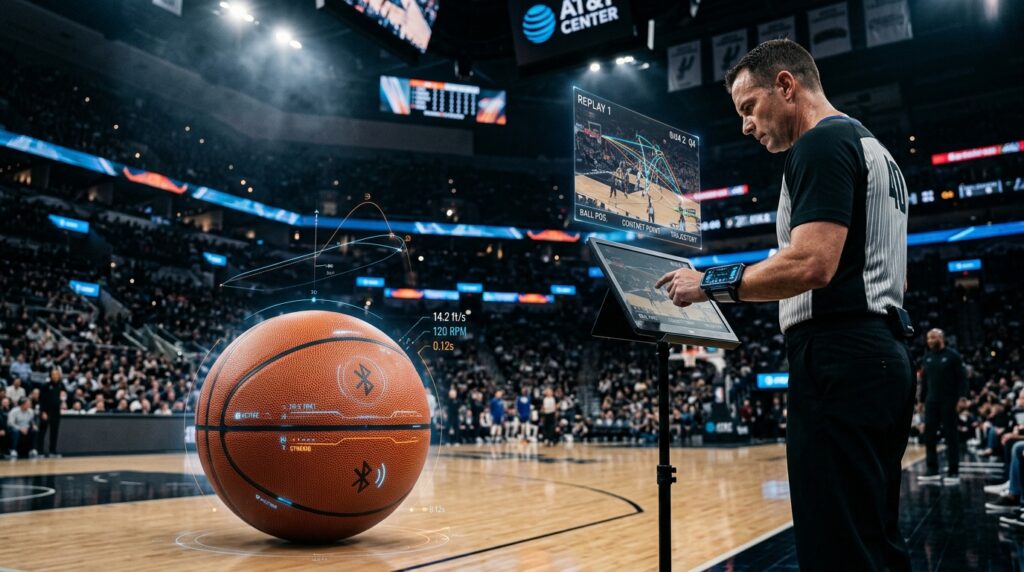
During selected exhibition games, players will use a specially developed Wilson basketball containing an embedded Bluetooth sensor.
The connected ball can collect information while the game is being played, giving the NBA another potential source of real-time data.
The league says the technology is currently being used strictly for research.
That means information collected from the smart basketball will not affect officiating decisions during the preseason games being used for testing.
But the bigger opportunity is obvious.
If the technology proves accurate and reliable, connected basketballs could eventually help provide officials with additional data when reviewing difficult plays.
What Could a Smart Basketball Track?
The NBA has not said that all of these applications will be introduced, but connected-ball technology could potentially help measure information such as:
- Ball movement
- Shot trajectory
- Possession
- Passing activity
- Location of the basketball
- Timing of certain plays
- Whether the ball crossed a specific boundary or position
The most interesting application could eventually be officiating.
Imagine a close out-of-bounds decision where sensor information helps determine exactly when the ball was touched—or technology assisting officials with timing-related situations.
That appears to be the direction the NBA is researching.
NBA Referees Are Also Testing Wrist Wearables
The basketball isn’t the only piece of technology being tested.
Officials in selected preseason games will wear connected wrist devices designed to improve communication with the NBA Replay Center.
The devices can be used during specific situations such as:
- Replay reviews
- Scoring corrections
- Clock malfunctions
Instead of relying entirely on traditional communication methods, officials could receive information directly through a wearable device.
The NBA previously tested the technology during Summer League games and described the pilot program as successful.
Why Referee Wearables Could Matter
NBA officiating frequently involves situations where speed matters.
A scoring correction, replay decision or clock issue can interrupt a game while officials communicate with the replay center and determine what happened.
Wearable technology could potentially make that communication faster and more organized.
Rather than becoming another consumer smartwatch, these devices are essentially specialized communication tools built around officiating.
That distinction matters.
The NBA isn’t simply putting gadgets on referees—it is experimenting with a connected system that could reduce friction between officials on the court and league personnel reviewing plays remotely.
Don’t Expect This Technology During the Regular Season Yet
The NBA says the wearable technology will not continue into the regular season at this stage.
The connected basketball is also being used for research rather than live officiating decisions.
That makes preseason the league’s technology laboratory.
The NBA can test how the systems perform during real games without immediately allowing experimental technology to influence competitive regular-season results.
If the systems prove dependable, future testing could become much more significant.
The Bigger Picture: Sports Are Becoming Data Platforms
Professional sports are increasingly combining athletic competition with sensors, artificial intelligence, computer vision and real-time analytics.
Basketball is particularly suited for this transformation.
An NBA game already produces enormous amounts of information involving player movement, shooting locations, possession, timing and referee decisions.
Adding connected equipment creates another layer of data.
Eventually, a basketball game could involve multiple connected systems working together:
Smart ball + player tracking + arena cameras + AI analysis + referee wearables + replay technology.
Instead of relying on one technology, the NBA could potentially combine multiple data sources to make difficult decisions more accurately.
Could AI Eventually Become Part of NBA Officiating?
That is where this becomes especially interesting.
A connected basketball alone doesn’t automatically create automated officiating.
But once leagues begin collecting reliable real-time sensor data, artificial intelligence can potentially analyze that information alongside camera footage and player-tracking systems.
Future systems could theoretically flag events such as:
- Out-of-bounds situations
- Shot-clock violations
- Timing discrepancies
- Possible goaltending
- Possession questions
- Scoring mistakes
Human officials could then review the technology’s recommendation instead of allowing AI to make the final decision automatically.
That hybrid model may be much more realistic than completely replacing referees.
What This Means for Sports Technology Companies
The NBA’s experiment is also worth watching from a business perspective.
Professional sports leagues represent enormous testing grounds for technologies involving:
- IoT sensors
- Bluetooth tracking
- Wearable devices
- AI video analysis
- Computer vision
- Sports analytics
- Real-time communications
- Data infrastructure
If technologies like connected basketballs become standard, opportunities won’t be limited to professional basketball.
Similar systems could eventually spread into college sports, training facilities, youth leagues and consumer athletic equipment.
That creates potential opportunities for technology companies building the sensors, software platforms and analytics systems behind connected sports.
Aqyreon Take
The smart basketball may sound like a small experiment, but it represents something much larger.
Sports equipment is gradually becoming connected technology.
A basketball that once provided almost no digital information could eventually become another real-time data source feeding analytics platforms, replay systems and potentially AI-assisted officiating.
The NBA isn’t handing control of games over to technology yet.
But by testing smart basketballs and referee wearables during the preseason, the league is building the infrastructure needed to determine whether technology can make basketball officiating faster, more accurate and more connected.
And if the experiments work, the basketball of the future may do much more than bounce.