Apple’s New M6 Mac Mini Is Built for the AI Era — And It Starts at $899
Apple has unveiled a new generation of the Mac mini, and this time the tiny desktop is being positioned as much more than an affordable Mac.
With the new M6 chip, upgraded M5 Pro option, significantly stronger AI performance, faster networking, and support for Apple’s next-generation AI features, the Mac mini is increasingly becoming a compact workstation for local artificial intelligence, automation, content creation, development, and always-on AI agents.
Apple says the M6 Mac mini can deliver up to four times faster AI performance, twice the graphics and storage performance, and 40% faster CPU performance compared with previous configurations.
That could make this one of Apple’s most interesting computers yet for people looking to experiment with AI without spending Mac Studio-level money.
What’s New With the M6 Mac Mini?
The biggest upgrade is Apple’s new M6 processor.
The M6 Mac mini comes with a 12-core CPU and 12-core GPU, adding two CPU and GPU cores compared with the previous generation.
More importantly for AI workloads, Apple has added Neural Accelerators directly into each GPU core.
According to Apple, this combination gives the Mac mini:
- Up to 4x faster AI performance
- Up to 2x faster graphics
- Up to 2x faster Neural Engine performance
- Memory bandwidth of up to 170GB/s
- Up to 32GB of unified memory
The standard configuration starts with 16GB of unified memory.
This is important because AI applications increasingly depend not only on traditional CPU performance but also on GPUs, specialized neural processing hardware, and fast access to memory.
Apple Wants the Mac Mini to Become an AI Machine
Apple is making something particularly clear with this generation:
The Mac mini isn’t just being marketed as a small desktop anymore.
Apple increasingly sees it as an AI workstation.
The company says users can run AI workloads directly on the machine, including:
- Local large language models
- AI-powered photo processing
- Image generation models
- AI automation
- AI agents that perform repetitive tasks
Apple specifically highlights the ability to create AI agents capable of automating daily workflows directly on the Mac.
That last capability could become increasingly important.
Instead of every AI task being processed through services such as ChatGPT, Claude, Gemini, or other cloud platforms, developers are increasingly experimenting with models that can run directly on personal computers.
Local AI can potentially provide several advantages.
Better Privacy
Sensitive information may remain on the user’s computer instead of being continuously uploaded to cloud AI servers.
Lower AI Costs
Running models locally can reduce dependence on paid API calls.
Faster Automation
AI agents running continuously on a local machine could monitor folders, process documents, organize information, analyze data, and perform routine tasks automatically.
Offline AI
Certain models can continue working even when an internet connection isn’t available.
This makes small, energy-efficient computers such as the Mac mini increasingly interesting for AI enthusiasts.
The Performance Numbers Are Impressive
Apple also provided several benchmark comparisons for the M6 Mac mini.
In LM Studio, which allows users to run large language models locally, Apple claims the M6 Mac mini provides up to:
13.5x faster LLM prompt processing than the M1 Mac mini.
Compared with the M4 Mac mini, performance can be up to 4.8x faster.
Apple also claims:
- Up to 2.3x faster Microsoft Excel calculations compared with M1
- Up to 2x faster Cyberpunk 2077 gaming performance with ray tracing compared with M4
Those numbers suggest Apple isn’t only targeting AI developers.
The new Mac mini remains a general-purpose desktop for office productivity, gaming, programming, content creation, and home computing.
Then There’s the M5 Pro Mac Mini
People who need considerably more computing power can choose the M5 Pro version.
Interestingly, Apple is offering M6 for the mainstream Mac mini while positioning the M5 Pro as the higher-performance professional configuration.
The M5 Pro version can be configured with:
- Up to an 18-core CPU
- Up to a 20-core GPU
- Neural Accelerators inside GPU cores
- Up to 64GB unified memory
- Up to 307GB/s memory bandwidth
Apple says the machine is designed for workloads including:
- App development
- 3D design
- Video rendering
- Scientific simulations
- Visual effects
- Game development
- Large AI models
- AI image processing
- Research datasets
This could make the M5 Pro Mac mini particularly attractive to AI developers who need more memory.
Memory is becoming increasingly important for local AI because larger models require significantly more RAM.
A 64GB configuration could allow developers to experiment with substantially larger models than the standard M6 configuration.
You Can Even Cluster Multiple Mac Minis for AI
One of the more interesting features is support for Thunderbolt 5 on the M5 Pro Mac mini.
Apple says multiple Mac minis can be connected together to run larger AI models locally.
The M6 version includes three Thunderbolt 4 ports, while the M5 Pro configuration includes three Thunderbolt 5 ports.
Apple specifically says Thunderbolt 5 can be used to cluster multiple Mac mini systems together for large AI models.
That opens up some interesting possibilities.
Instead of purchasing one extremely expensive workstation, developers or small businesses could theoretically build a cluster of Mac minis dedicated to AI workloads.
It won’t replace enterprise-grade GPU servers for large-scale AI training, but it could become an interesting option for smaller AI development environments.
Connectivity Gets a Major Upgrade
Apple has also modernized the Mac mini’s connectivity.
Both versions now support:
Wi-Fi 7
Bluetooth 6
2.5Gb Ethernet
Users can also configure the system with 10Gb Ethernet.
On the front are:
- Two USB-C ports
- Headphone jack
On the rear:
M6 Mac Mini
- Three Thunderbolt 4 ports
- HDMI
- Ethernet
M5 Pro Mac Mini
- Three Thunderbolt 5 ports
- HDMI
- Ethernet
The faster networking options could be particularly useful for businesses running local servers, network storage systems, AI workloads, or media production environments.
macOS 27 Brings Siri AI
The new hardware will also work closely with macOS 27 Golden Gate, Apple’s upcoming operating system.
One of its biggest changes is the introduction of Siri AI.
Apple says Siri will be able to use personal context across information such as:
- Messages
- Emails
- Photos
- Applications
- Information displayed on the screen
Users will also be able to ask Siri questions about what is currently displayed using Visual Intelligence.
Siri AI will be integrated into Spotlight and system-wide menus, while users will also be able to write and edit text with Siri across supported applications.
Apple Intelligence will also expand automation capabilities.
For example, users will reportedly be able to create automations inside Shortcuts simply by describing what they want the system to do.
That could make automation dramatically easier for nontechnical users.
Instead of manually building complex workflows, someone could simply describe the task they want automated.
A Perfect Computer for Always-On AI Agents?
Perhaps the most interesting part of Apple’s announcement is how frequently the company refers to agentic computing.
AI agents are software systems capable of performing tasks independently rather than simply answering questions.
For example, an AI agent could potentially:
- Monitor incoming emails
- Organize documents
- Generate reports
- Analyze spreadsheets
- Track business information
- Process customer requests
- Monitor cybersecurity alerts
- Research competitors
- Prepare social media content
- Automate administrative workflows
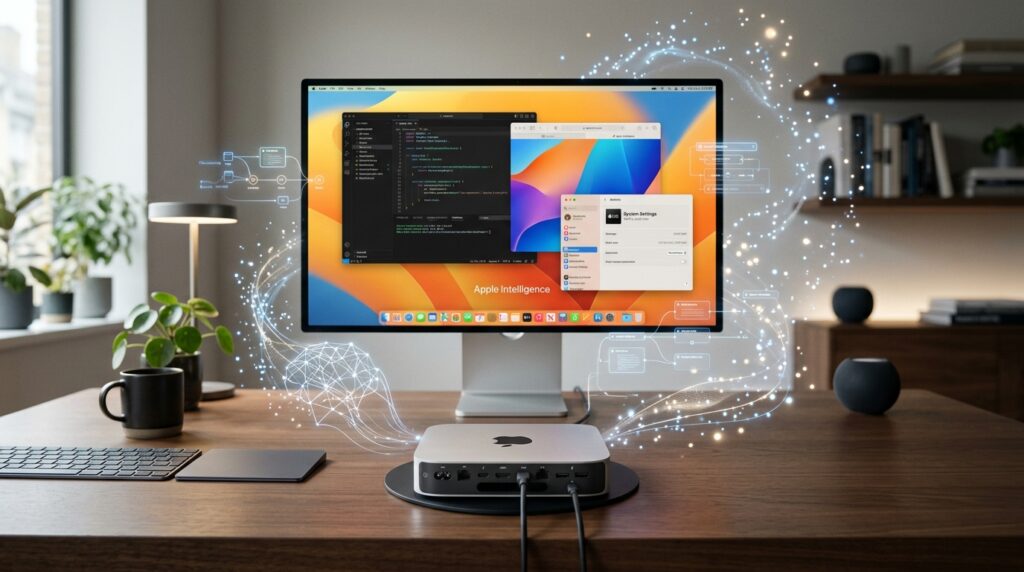
Because the Mac mini is small, relatively energy efficient, and designed to remain powered on continuously, it could become an attractive machine for running these types of systems.
A small business could theoretically keep a Mac mini operating in the office as a dedicated AI automation computer.
Developers could also use one as a relatively inexpensive local AI development server.
Apple itself describes the Mac mini as suitable for “always-on, deskside agentic computing.”
That language is significant.
Apple clearly expects AI agents to become an important part of everyday computing.
The Design Is Still Extremely Small
Despite the performance improvements, Apple hasn’t abandoned what makes the Mac mini attractive.
It remains an extremely compact desktop.
That means it can easily sit underneath a monitor, inside a studio, in a home office, or even inside business IT environments without occupying much space.
Apple is increasingly positioning the computer as something that can serve several roles:
A family computer.
A professional workstation.
A developer machine.
A content creation computer.
A small business desktop.
Or even a dedicated AI server.
Apple Is Also Pushing Sustainability
Apple says approximately 50% of the material used in the new Mac mini is recycled.
That includes:
- 100% recycled aluminum in the enclosure
- 100% recycled rare-earth elements in magnets
Apple also says electricity used during manufacturing comes from renewable sources such as wind and solar.
The company continues working toward its larger goal of becoming carbon neutral across its footprint.
M6 Mac Mini Price
The good news is that Apple hasn’t positioned the base machine at workstation-level pricing.
Mac Mini with M6
Starting price:
$899
Education price:
$799
Mac Mini with M5 Pro
Starting price:
$1,699
Education price:
$1,599
Apple says preorders began August 25, with availability beginning September 22.
Should You Buy the M6 Mac Mini?
That depends heavily on what you already own.
For people using older M1 or Intel Macs, the performance improvement could be substantial.
The M6 version makes the most sense for:
- Home users
- Students
- Office workers
- Developers
- Content creators
- Small businesses
- AI enthusiasts
- People experimenting with local AI models
The M5 Pro configuration makes more sense for users handling:
- Large AI models
- Professional video editing
- 3D rendering
- Game development
- Scientific workloads
- Large datasets
- Advanced software development
But users who recently purchased an M4 Mac mini may have less reason to upgrade unless AI workloads are becoming a major part of their workflow.
What This Means for Businesses
This is where the new Mac mini becomes particularly interesting.
The AI industry has largely focused on massive data centers filled with expensive Nvidia GPUs.
But another computing trend is emerging:
AI is moving closer to the user.
Instead of sending every request to cloud servers, more AI models could eventually run directly inside homes and offices.
Small computers like the Mac mini could become part of that infrastructure.
Imagine a business using one Mac mini to continuously operate:
Customer-support AI.
Document-processing AI.
Marketing automation.
Internal knowledge assistants.
Data-analysis agents.
Cybersecurity monitoring tools.
Content-generation workflows.
Software-development assistants.
For small companies, that could reduce dependence on expensive cloud infrastructure.
Aqyreon Take
The new Mac mini may look almost identical to previous generations, but what Apple is trying to turn it into is considerably more ambitious.
This isn’t simply a faster desktop.
Apple appears to be preparing the Mac mini for a future where AI agents run continuously in the background and computers increasingly perform tasks on behalf of their users.
The M6’s improved AI hardware, faster memory architecture, stronger networking, and local model capabilities make the Mac mini one of the more interesting entry points into that future.
At $899, it could also become an affordable experimentation platform for developers, creators, entrepreneurs, and small businesses that want to explore local AI.
The bigger story isn’t necessarily the M6 chip itself.
It’s Apple’s growing belief that the next generation of personal computers won’t just run applications.
They’ll run AI agents that work for you.